W or na in Polish: how to choose the right preposition of place (w pracy, na budowie)


English has one little word for almost everything: "at work", "at the station", "in the office". Polish splits the job between two prepositions, w and na, and the split does not follow English. People who have just arrived often say "jestem na pracy" or "pracuję na fabryce" because the preposition feels natural from their own language. A Pole understands, but hears the mistake, and it is one of the most recognisable ones.
The good news is that the rule is quite logical. There are two prepositions of place and one quick way to choose between them. Below we go through it, then walk through the workplace words you meet every day, and finish with a short practice section with answers.
The basic scheme: an enclosed space or a surface
In simple terms, w means "inside something enclosed", and na means "on a surface, in an open place, or at an event". So:
- w — rooms, buildings, cities, most countries, organisations seen as a space: w biurze, w sklepie, w domu, w szkole, w szpitalu, w Warszawie, w Polsce, w Niemczech.
- na — open places, surfaces, events, transport hubs: na ulicy, na dworcu, na lotnisku, na budowie, na placu, na przystanku, na spotkaniu, na urlopie.
After both prepositions the noun takes the locative case (miejscownik), so the endings change: biuro → w biurze, budowa → na budowie, Warszawa → w Warszawie. The case system is covered in our cheat sheet; here the point is the preposition.
Workplace words to learn by heart
This is where mistakes are most frequent, because each word has to be learned as a pair.
- w pracy — at work. Not "na pracy". It is an abstract idea, and the preposition is the same as in "w domu".
- na budowie — on a building site. A site is an open area.
- na magazynie — in a warehouse in the sense of working there: pracuję na magazynie. If you mean the building itself you will also hear w magazynie: towar jest w magazynie.
- na hali — on the shop floor or a large production area.
- na produkcji — in production: pracuję na produkcji.
- w fabryce — in a factory. Here it really is "in", not "on".
- w firmie — in a company.
- na zmianie — on a shift: jestem na nocnej zmianie.
- na stanowisku — in a position or at a workstation.
- na umowie — on a contract: pracuję na umowie zlecenie.
- na zwolnieniu — on sick leave (people often say na L4).
Countries and regions: why "na Ukrainie"
For countries there is a rule you simply have to memorise. Most countries take w: w Polsce, w Niemczech, w Czechach, w Hiszpanii, w Anglii. A few traditionally take na: na Litwie, na Łotwie, na Słowacji, na Węgrzech, na Białorusi, na Ukrainie. With Ukraine there is a nuance: the traditional Polish form is na Ukrainie and it is the standard one. In recent years many Poles have also deliberately used w Ukrainie, and both variants are considered correct. If you are talking about your own country, neither form will be a mistake.
Regions also often take na: na Mazowszu, na Śląsku, na Podhalu, na Pomorzu. Cities, on the other hand, always take w: w Krakowie, w Gdańsku, w Łodzi, we Wrocławiu (an e is added before Wr- to make it easier to pronounce).
Where and where to: the key pair
The preposition differs when you answer "where?" and "where to?", and this is the second big trap. For "where?" (gdzie?) we use w or na with the locative. For "where to?" (dokąd?) we use do with the genitive or na with the accusative.
- w pracy → do pracy. Jestem w pracy. Idę do pracy.
- w sklepie → do sklepu. Jestem w sklepie. Idę do sklepu.
- w biurze → do biura. Czekam w biurze. Idę do biura.
- na budowie → na budowę. Pracuję na budowie. Jadę na budowę.
- na poczcie → na pocztę. Jestem na poczcie. Idę na pocztę.
- na dworcu → na dworzec. Czekam na dworcu. Jadę na dworzec.
An easy way to remember: if "where?" takes na, "where to?" takes na too (but in the accusative). If "where?" takes w, "where to?" almost always takes do.
Three typical mistakes and how to fix them
- "Pracuję na fabryce". Correct: pracuję w fabryce. A factory takes "in", like an office.
- "Idę na pracę". Correct: idę do pracy. Work as a destination takes do.
- "Mieszkam na Warszawie". Correct: mieszkam w Warszawie. Cities always take w.
Phrases for everyday life
Here are a few ready-made constructions you can use almost unchanged at work and around town.
- Jestem już w pracy. — I'm already at work.
- Pracuję na nocnej zmianie. — I work the night shift.
- Spotkajmy się na przystanku. — Let's meet at the bus stop.
- Mieszkam w Poznaniu, ale pracuję na budowie pod Gnieznem. — I live in Poznań but work on a building site near Gniezno.
- Jadę na dworzec, a potem do domu. — I'm going to the station, and then home.
- Dziś jestem na urlopie. — I'm on holiday today.
Practice: fill in w, na or do
Try to fill in the gaps without peeking at the answers.
- Mieszkam ___ Warszawie.
- Pracuję ___ budowie.
- Jutro idę ___ pracy.
- Jadę ___ dworzec.
- Jestem ___ urlopie.
- Ona mieszka ___ Niemczech, a on ___ Ukrainie.
- Czekam ___ przystanku.
- Siedzę ___ domu i uczę się.
Answers: 1 — w (w Warszawie); 2 — na (na budowie); 3 — do (do pracy); 4 — na (na dworzec); 5 — na (na urlopie); 6 — w Niemczech, na Ukrainie; 7 — na (na przystanku); 8 — w (w domu).
How to make it stick
A simple habit works best: every time "on" or "at" pops into your head, stop and ask yourself what kind of place it is — a room or an open area. After a week the choice becomes automatic. And for the awkward cases such as magazyn or Ukraina, just write them in your notes: there are not many.
Subscribe to our newsletter:
Latest Posts:


More in this section: Polish grammar rules in plain words

Personal pronouns in Polish: go or jego, cię or ciebie, do niego, z nią
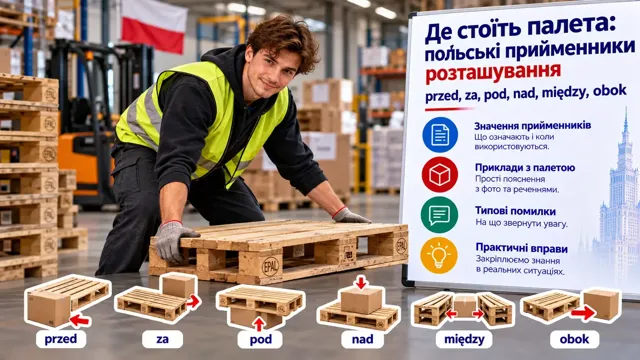
Where is the pallet? Polish prepositions of position: przed, za, pod, nad, między, obok

Verbs and their cases in Polish: szukam pracy, pomagam koledze, czekam na autobus