Numbers with nouns in Polish: dwa psy, pięć psów, 22 lata, 5 złotych
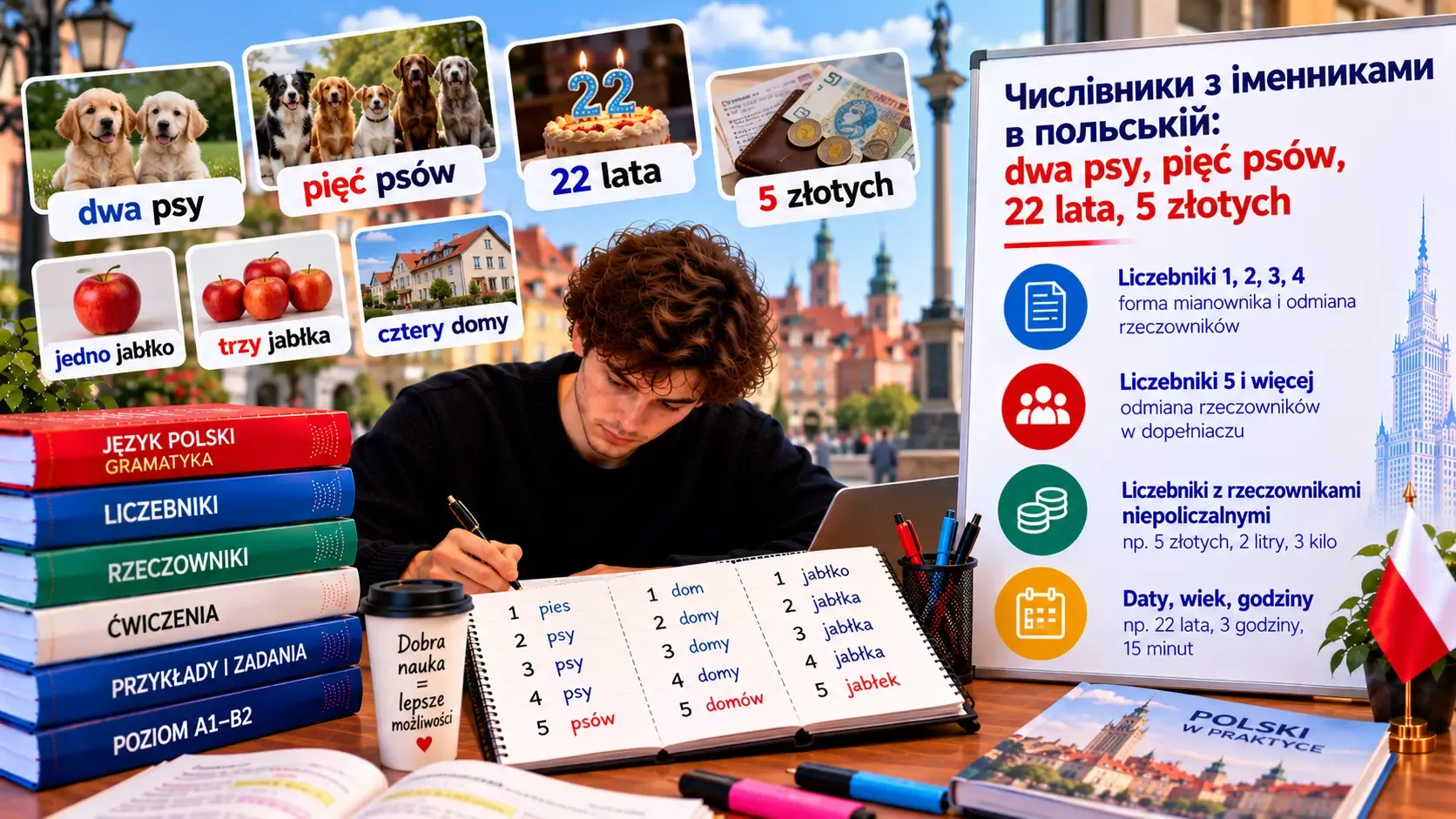

Ask any learner what is hardest in Polish and numbers are near the top. Not the words themselves — "jeden, dwa, trzy" are learned in an evening — but what comes after them. "Mam dwa psy" or "mam dwa psów"? "Pięć złote" or "pięć złotych"? "Dwadzieścia dwa lat" or "lata"? The rule is one, it has a few sub-rules, but after a little practice it works automatically. Let us go through it with examples that turn up at work every day.
Three groups: one, two to four, five and more
After a number the noun changes its form depending on the quantity:
- 1 — the noun in the singular: jeden pies, jedna kobieta, jedno okno.
- 2, 3, 4 — the nominative plural: dwa psy, trzy kobiety, cztery okna.
- 5 and more — the genitive plural: pięć psów, sześć kobiet, siedem okien.
The genitive plural has its own endings (-ów, -i/-y, or none), which have to be learned along with the noun.
The gender of "two"
The number 2 has two forms: dwa for masculine and neuter, dwie for feminine. So: dwa kartony, dwa okna, dwie palety, dwie zmiany. For male persons there is a special form dwaj, trzej, czterej (dwaj pracownicy), but in speech people more often say dwóch pracowników — with the genitive.
Compound numbers: 12–14 and 22–24
This is where most mistakes happen. The rule: all numbers from 5 to 21 require the genitive plural, including 12, 13, 14 (dwanaście psów, trzynaście palet, czternaście godzin). After that, numbers ending in 2, 3, 4 (22, 23, 24, 32, 33, 34…) require the nominative plural: dwadzieścia dwa psy, trzydzieści trzy palety. And numbers ending in 5–9 or 0 and 1 (above twenty) take the genitive again: dwadzieścia jeden psów, trzydzieści pięć palet.
Money: złoty, złote, złotych
Prices and salaries are the most common place for these forms:
- 1 złoty (nominative singular), 2–4 złote, 5 and more złotych.
- 1 grosz, 2–4 grosze, 5 and more groszy.
Examples: To kosztuje dwa złote. Płacę dwadzieścia złotych. Mam pięćset złotych. Zarabiam trzydzieści złotych na godzinę. The same rule applies to 22 and 32: dwadzieścia dwa złote, trzydzieści dwa złote.
Age: rok, lata, lat
The word for "year" is doubly complicated because it has a special plural form:
- 1 rok: Mam rok. — I'm one year old.
- 2–4 lata: Mam dwa lata, trzy lata, cztery lata.
- 5 and more lat: Mam pięć lat, dwadzieścia lat, pięćdziesiąt lat.
- 22, 23, 24 — lata: Mam dwadzieścia dwa lata.
- 12, 13, 14 and 21, 31 — lat: Mam czternaście lat. Mam dwadzieścia jeden lat.
Time and days at work
Words related to the work schedule follow the same rule:
- godzina: jedna godzina, dwie godziny, pięć godzin.
- dzień: jeden dzień, dwa dni, pięć dni.
- tydzień: jeden tydzień, dwa tygodnie, pięć tygodni.
- miesiąc: jeden miesiąc, dwa miesiące, pięć miesięcy.
- zmiana: jedna zmiana, dwie zmiany, pięć zmian.
Hence the typical phrases from adverts: pracujemy osiem godzin dziennie, pięć dni w tygodniu, na dwie zmiany. Notice that after osiem godzin there is no "w", and "w tygodniu" stands in the locative.
People are counted differently
For male persons in the plural there is a special form of the numerals: dwóch pracowników, trzech kierowców, pięciu mężczyzn. For women and objects it does not apply: dwie kobiety, pięć palet. In conversation at work you will most often hear this version: Potrzebujemy trzech magazynierów — "We need three warehouse workers".
Inexact quantities: kilka, wiele, dużo, mało
When the quantity is vague, an even simpler rule applies: the words kilka, parę, wiele, dużo, mało, trochę require the genitive. For countable things — the plural: kilka palet, parę dni, wiele osób. For uncountable ones — the singular: dużo pracy, mało czasu, trochę pieniędzy. This is very useful at work: Mam dużo pracy ("I have a lot of work"), Zostało kilka godzin ("A few hours are left").
A dialogue about salary
- — Ile lat pan ma? — How old are you?
- — Mam dwadzieścia trzy lata. — I'm twenty-three.
- — Ile godzin dziennie może pan pracować? — How many hours a day can you work?
- — Osiem lub dziesięć godzin, pięć dni w tygodniu. — Eight or ten hours, five days a week.
- — Proponujemy trzydzieści dwa złote na godzinę. — We offer thirty-two zloty an hour.
Three typical mistakes
- "Pięć złote". Correct: pięć złotych. After five — the genitive plural.
- "Mam dwadzieścia dwa lat". Correct: dwadzieścia dwa lata. The number ends in 2, so the nominative plural.
- "Dwanaście godziny". Correct: dwanaście godzin. Numbers 12–14 require the genitive.
Practice: put the word in the right form
Put the word in brackets into the required form after the number.
- Mam trzy ___ (pies).
- Kupuję pięć ___ (karton).
- Pracuję osiem ___ (godzina).
- To kosztuje dwadzieścia ___ (złoty).
- Mam dwadzieścia dwa ___ (rok).
- Pracujemy pięć ___ w tygodniu (dzień).
- Potrzebujemy cztery ___ (paleta).
- Mam trzydzieści jeden ___ (rok).
Answers: 1 — psy; 2 — kartonów; 3 — godzin; 4 — złotych; 5 — lata; 6 — dni; 7 — palety; 8 — lat.
Summary
If you remember one rule, it is this: 1 — singular, 2–4 — nominative plural, 5+ — genitive plural, and the exceptions are 12–14 (genitive) and 22–24 (nominative plural). Practice does the rest: you will say the word "godzin" a hundred times at work.
Subscribe to our newsletter:
Latest Posts:

More in this section: Polish grammar rules in plain words
Adjectives in Polish: dobry, dobra, dobre, dobrzy — gender, number and case in one scheme
Questions and word order in Polish: czy, gdzie, dokąd, ile, z kim
Where is the pallet? Polish prepositions of position: przed, za, pod, nad, między, obok