Personal pronouns in Polish: go or jego, cię or ciebie, do niego, z nią
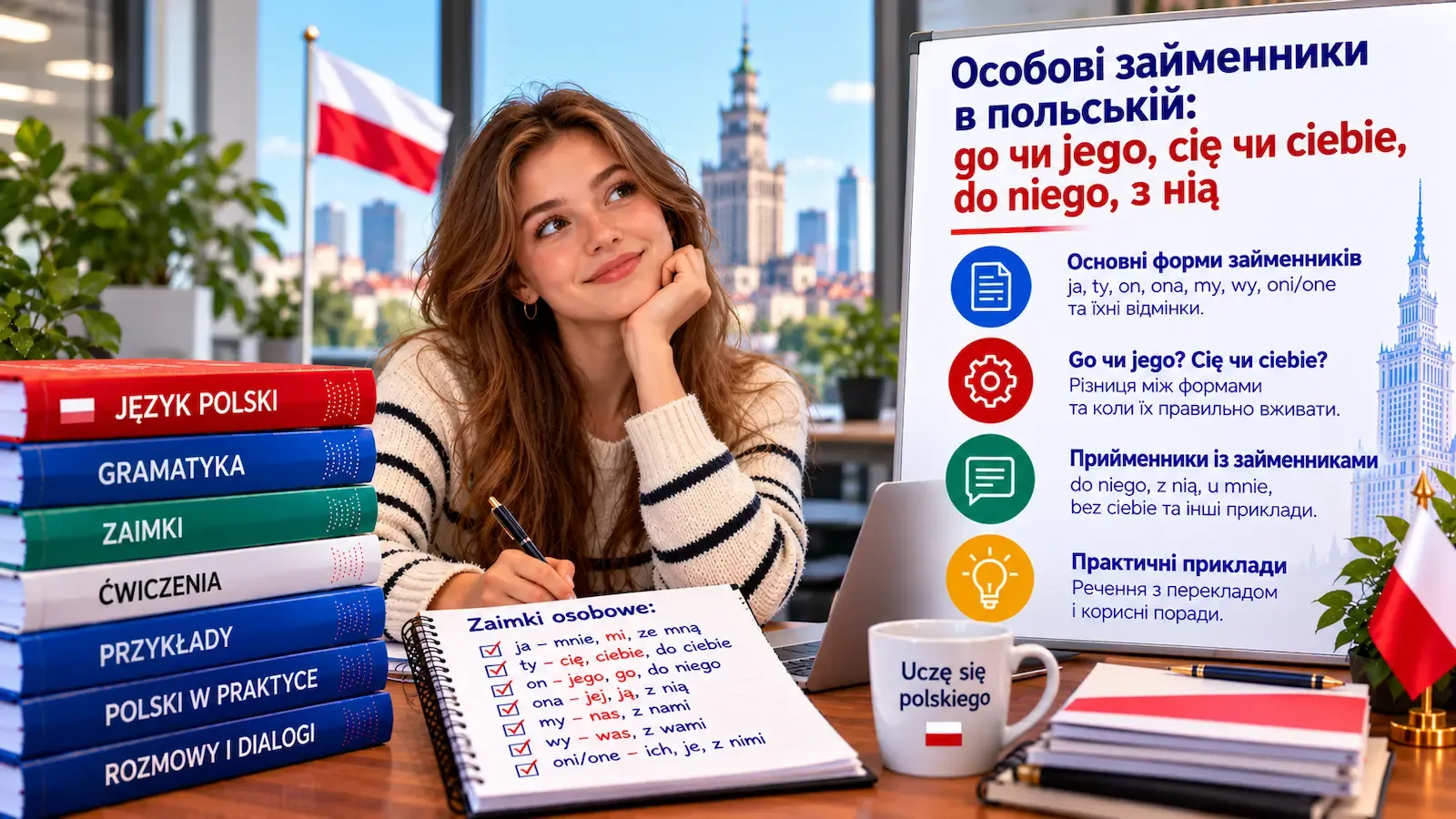

The words "I", "you", "he" in Polish have many forms, and we most often see them not in the nominative but in the oblique cases: "I'll see you", "I'll call him", "I'm talking to her". This is where beginners get confused: Polish has short forms (go, cię, mu) and long ones (jego, ciebie, jemu), and after a preposition the first letter changes as well (do niego, not "do jego"). Let us go through the system so that at work you answer without hesitation "Have you seen him?" and "Who did he call?".
The set of forms: once and for all
Here is the declension of the personal pronouns in the cases you need every day. In brackets is the form after a preposition:
- ja: mnie (genitive, accusative, locative); mi / mnie (dative); mną (instrumental).
- ty: ciebie, cię (genitive, accusative); ci / tobie (dative); tobą (instrumental); o tobie.
- on: jego, go (genitive, accusative; after a preposition niego); mu / jemu (dative; niemu); nim (instrumental).
- ona: jej (genitive and dative; niej); ją (accusative; nią); nią (instrumental).
- my: nas; nam; nami.
- wy: was; wam; wami.
- oni: ich (nich); im (nim); nimi.
Short and long forms
Short forms (cię, go, mu, ci, mi) are used in neutral speech, carry no stress and do not stand at the start of a sentence. Long ones (ciebie, jego, jemu, tobie, mnie) are used when we want to stress or contrast, or when the pronoun stands first or after a preposition.
- Znam go. — I know him. (neutral) — Jego znam, a ją nie. — Him I know, her I don't.
- Widzę cię. — I see you. — Ciebie szukam. — It's you I'm looking for.
- Daję mu klucz. — I give him the key. — Jemu daję klucz, nie tobie. — I give the key to him, not to you.
The j → n rule after a preposition
This is the most important detail. After a preposition, third-person pronouns that begin with j- or i- change the beginning to n-:
- jego → niego: dla niego, do niego, od niego, bez niego.
- jemu → niemu: dzięki niemu, ku niemu.
- jej → niej: dla niej, do niej, od niej, bez niej.
- ją → nią: przez nią, na nią, za nią.
- ich → nich: dla nich, do nich, od nich.
- im → nim: dzięki nim.
In other words, "do jego" does not exist, only do niego; "z on" does not exist, only z nim. The rule does not apply to first and second person pronouns: do mnie, dla ciebie, o tobie.
Instrumental and locative
- Rozmawiam z nim. — I'm talking to him.
- Rozmawiam z nią. — I'm talking to her.
- Rozmawiasz ze mną. — You're talking to me.
- Rozmawiam z tobą. — I'm talking to you.
- Rozmawiamy z nimi. — We're talking to them.
- Myślę o nim, o niej, o was. — I'm thinking of him, of her, of you.
The pronoun "I" after prepositions
The first-person pronoun has a few special combinations in the oblique cases that simply have to be memorised: ze mną, beze mnie, ode mnie, przeze mnie, przede mną, nade mną, dla mnie, do mnie, o mnie, na mnie, u mnie. Examples: Zostań ze mną. Zrób to dla mnie. Klucz dostaniesz ode mnie. Przede mną stoi kolejka. The same group includes ciebie → tobie / tobą: dla ciebie, o tobie, z tobą.
He, she and they: ich or je
For the plural Polish distinguishes the masculine-personal form from everything else. If the group includes men, we use ich / im / nimi: Znam ich. Pomagam im. For women, children, animals and things — je in the accusative: Widzę je (about girls or objects). This works in the same way as in the plural of the past tense (byli — były).
Pointer words: whom, to whom
To choose the form, first determine the case from the verb or preposition. A few useful verbs:
- pomagać komu (to help): Pomagam mu, pomagam jej.
- dziękować komu (to thank): Dziękuję ci, dziękuję wam.
- dzwonić do kogo (to call): Dzwonię do niego, do niej.
- pytać kogo (to ask): Pytam ją, pytam go.
- czekać na kogo (to wait): Czekam na ciebie, na nich.
- znać kogo: Znam go, znam ją.
Work examples
- Szef dzwoni do mnie codziennie. — The boss calls me every day.
- Daj mi paletę. — Give me a pallet.
- Pomogę ci z kartonami. — I'll help you with the boxes.
- Czekam na ciebie przy bramie. — I'm waiting for you at the gate.
- Nie widziałem go dziś w pracy. — I haven't seen him at work today.
- Rozmawiałem z nią o grafiku. — I talked to her about the schedule.
- Dziękuję wam za pomoc. — Thank you for your help.
A dialogue in the warehouse
- — Widziałeś Marka? — Have you seen Marek?
- — Tak, widziałem go rano. Rozmawiałem z nim o zmianie. — Yes, I saw him in the morning. I talked to him about the shift.
- — A Anię? — And Ania?
- — Jej dziś nie ma. Zadzwoń do niej, jeśli chcesz. — She isn't here today. Call her if you like.
Three typical mistakes
- "Dzwonię do jego". Correct: dzwonię do niego. After a preposition j → n.
- "Dla mi". Correct: dla mnie. After a preposition the long form is needed.
- "Go widzę". At the start of a sentence a long form is better, or reorder: Widzę go or Jego widzę.
Practice
Put the pronoun in the correct form.
- Znam ___ (he).
- Dzwonię do ___ (he).
- Rozmawiam z ___ (she).
- Daję ___ klucz. (you, dative)
- Czekam na ___ (you, plural)
- Pomagam ___ (she).
- Myślę o ___ (they).
- Dziękuję ___ za pomoc. (you, plural)
Answers: 1 — go; 2 — niego; 3 — nią; 4 — ci; 5 — was; 6 — jej; 7 — nich; 8 — wam.
Summary
For a quick choice remember: in neutral speech take the short form (go, cię, mu), to stress take the long one (jego, ciebie, jemu), and after a preposition put n- for the third person (do niego, z nią, dla nich). That is enough for conversation at work to sound natural.
Subscribe to our newsletter:
Latest Posts:
Latest Posts:
Verbs and their cases in Polish: szukam pracy, pomagam koledze, czekam na autobus

Addressing people in Polish: Panie Marku, Pani Anno, Aniu — the vocative
Comparatives and superlatives in Polish: lepszy, tańszy, najlepszy, im więcej — tym więcej
Citizenship and permanent residence in Poland 2026: what has and has not changed