Comparatives and superlatives in Polish: lepszy, tańszy, najlepszy, im więcej — tym więcej

When looking for work we compare all the time: "a higher rate", "closer to home", "an easier shift", "the best offer". In Polish these words are formed by a scheme close to English in spirit but with their own features: a few irregular forms, two ways of saying "than" and separate forms for adverbs. Let us go through everything in logical order.
Three degrees of the adjective
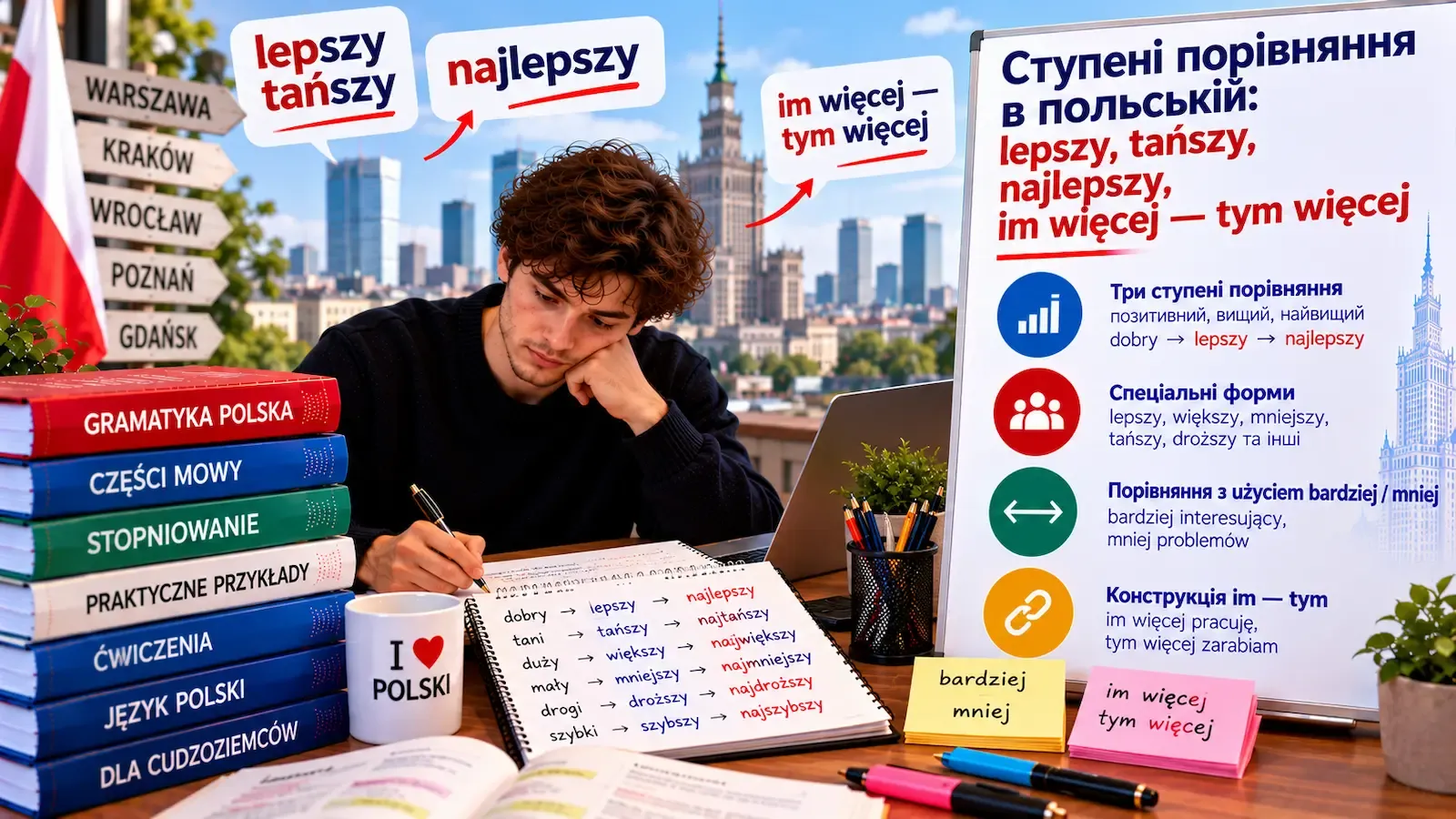
Polish, like English, has three degrees: positive (wysoki — tall), comparative (wyższy — taller) and superlative (najwyższy — tallest). The superlative is formed by adding the prefix naj- to the comparative: wyższy → najwyższy, tańszy → najtańszy.
How the comparative is formed
The most common way is the suffix -szy (for adjectives ending in a hard consonant) or -iejszy. The adjective then declines as usual (lepszy, lepsza, lepsze):
- stary → starszy; młody → młodszy; tani → tańszy; drogi → droższy.
- ciekawy → ciekawszy; ważny → ważniejszy; łatwy → łatwiejszy; trudny → trudniejszy.
- długi → dłuższy; krótki → krótszy; bliski → bliższy; daleki → dalszy.
- wysoki → wyższy; niski → niższy; ciężki → cięższy; lekki → lżejszy.
In the comparative there is often an alternation of consonants (drogi — droższy, ciężki — cięższy), so the forms are worth learning as pairs.
Irregular forms worth knowing
- dobry → lepszy → najlepszy — good, better, best.
- zły → gorszy → najgorszy — bad, worse, worst.
- duży → większy → największy — big, bigger, biggest.
- mały → mniejszy → najmniejszy — small, smaller, smallest.
These four words turn up most often in conversations at work: lepsza oferta, gorsza zmiana, większa stawka, mniejszy zespół.
Descriptive forms: bardziej and mniej
For many long and complex adjectives (especially those in -ący) the comparative is formed descriptively: bardziej ("more") + adjective, najbardziej ("most"), and for reduction mniej ("less") and najmniej:
- bardziej męcząca praca — more tiring work.
- najbardziej niebezpieczne miejsce — the most dangerous place.
- mniej ciężka zmiana — a less heavy shift.
Do not combine both methods: bardziej lepszy is a mistake, you just need lepszy.
Comparison: niż, od, jak
When we compare two things there are two ways:
- niż + nominative: Ta praca jest lepsza niż tamta.
- od + genitive: Ta praca jest lepsza od tamtej.
Both are correct, but niż is more common in speech, and od when a short word follows. For equality we use tak samo … jak ("just as … as") or tak … jak: Ta praca jest tak samo ciężka jak tamta. Pracuję tak długo jak ty.
Adverbs and their degrees
Adverbs answering "how?" also have a comparative and a superlative. They are formed by changing the ending to -iej or -ej:
- dobrze → lepiej → najlepiej — well, better, best.
- źle → gorzej → najgorzej — badly, worse, worst.
- szybko → szybciej → najszybciej — fast, faster, fastest.
- wolno → wolniej → najwolniej — slowly.
- tanio → taniej; drogo → drożej — cheaply, expensively.
- często → częściej; rzadko → rzadziej — often, rarely.
- wcześnie → wcześniej; późno → później — early, late.
- dużo → więcej → najwięcej; mało → mniej → najmniej — a lot, little.
Im … tym: "the more … the more"
A useful construction for talking about earnings and time: Im więcej pracujesz, tym więcej zarabiasz. ("The more you work, the more you earn."). Also: Im szybciej, tym lepiej. ("The faster, the better.").
Phrases for work
- Szukam lepiej płatnej pracy. — I'm looking for better-paid work.
- To jest najlepsza oferta, jaką widziałem. — This is the best offer I've seen.
- Wolę pracować na dziennej zmianie. Jest łatwiej. — I prefer working the day shift. It's easier.
- Ta praca jest cięższa, ale lepiej płatna. — This job is harder but better paid.
- Mieszkam bliżej pracy niż ty. — I live closer to work than you.
- Dojeżdżam dłużej, ale taniej. — My commute is longer but cheaper.
A dialogue about choosing a job
- — Którą ofertę wybierasz? — Which offer are you choosing?
- — Tę z magazynu. Płacą więcej, ale praca jest cięższa. — The warehouse one. They pay more, but the work is harder.
- — A ta w fabryce? — And the factory one?
- — Jest łatwiejsza i bliżej domu, ale płacą mniej. Im więcej pracuję, tym lepiej, więc wybieram magazyn. — It's easier and closer to home, but they pay less. The more I work, the better, so I'm choosing the warehouse.
Three typical mistakes
- "Bardziej lepszy". Correct: lepszy. A double comparison is a mistake.
- "Więcej dobry". Correct: lepszy. For "dobry" the comparative is lepszy.
- "Lepiej praca". Correct: lepsza praca. An adjective goes with a noun, while the adverb lepiej goes with a verb.
Practice
Put the word in brackets into the required form.
- Ta praca jest ___ (dobry, comparative) niż tamta.
- To jest ___ (tani, superlative) mieszkanie.
- Pracuję ___ (dużo, comparative) niż ty.
- Ona mówi po polsku ___ (dobrze, comparative).
- Ten wózek jest ___ (duży, comparative) od tamtego.
- Im ___ (dużo, comparative) pracujesz, tym ___ (dużo, comparative) zarabiasz.
- Dojeżdżam ___ (długo, comparative), ale ___ (tanio, comparative).
- To jest ___ (ciężki, superlative) paleta.
Answers: 1 — lepsza; 2 — najtańsze; 3 — więcej; 4 — lepiej; 5 — większy; 6 — więcej, więcej; 7 — dłużej, taniej; 8 — najcięższa.
Summary
Remember the basics: the comparative is -szy / -iejszy, the superlative is naj- + comparative, the irregular ones are lepszy, gorszy, większy, mniejszy, adverbs take -iej (lepiej, szybciej), and the comparison is niż or od. That is enough to compare vacancies, shifts and working conditions.
Subscribe to our newsletter:
Latest Posts:
Latest Posts:

Personal pronouns in Polish: go or jego, cię or ciebie, do niego, z nią
Verbs and their cases in Polish: szukam pracy, pomagam koledze, czekam na autobus

Addressing people in Polish: Panie Marku, Pani Anno, Aniu — the vocative
Citizenship and permanent residence in Poland 2026: what has and has not changed