Verbs and their cases in Polish: szukam pracy, pomagam koledze, czekam na autobus
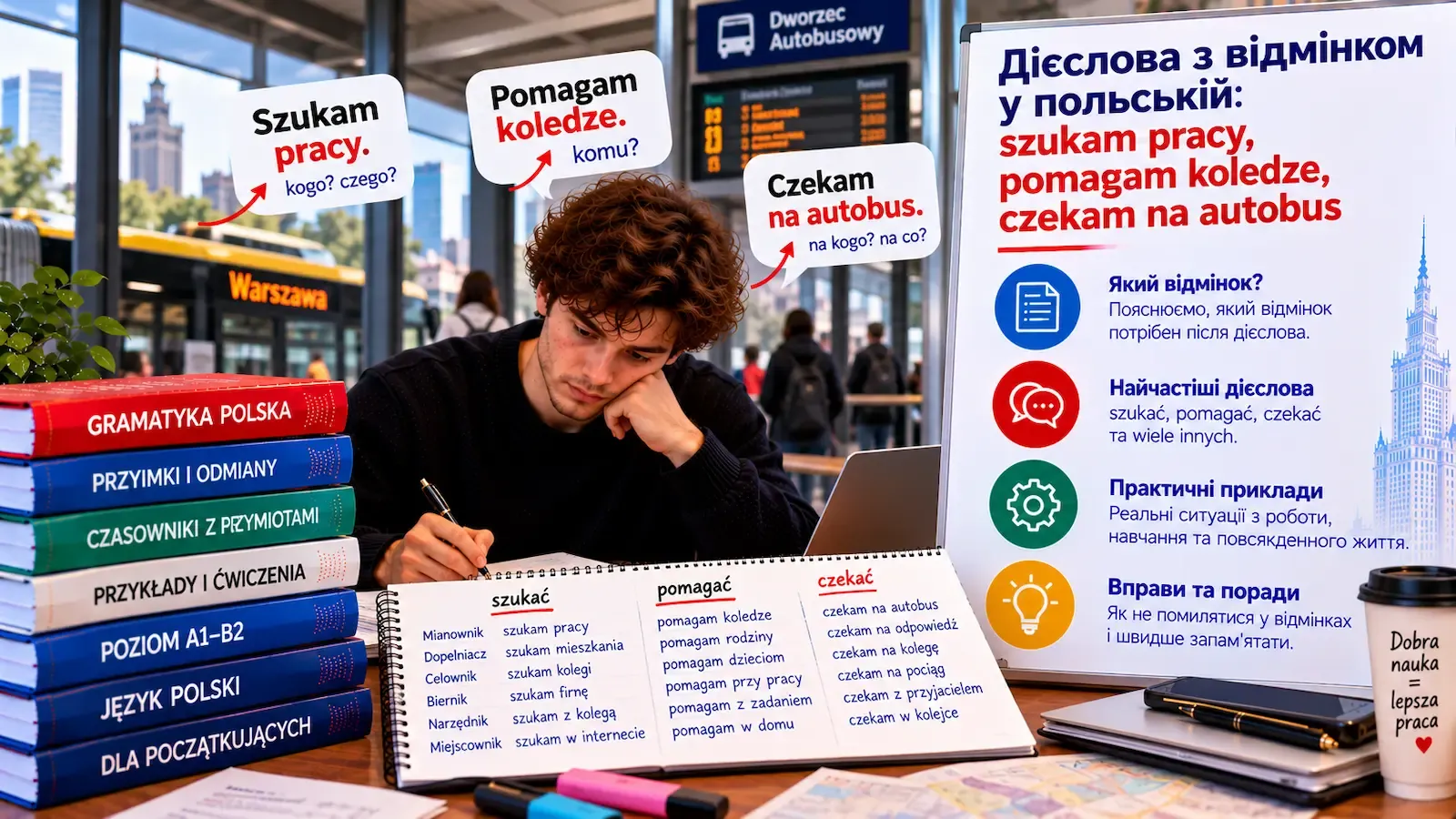

A learner of Polish quickly notices that words are similar but the cases after verbs are not always. In English we "look for work" with a preposition; in Polish it is szukam pracy (genitive, no preposition). "I help a colleague" is pomagam koledze (dative), "I wait for a bus" is czekam na autobus (a preposition and the accusative). In Polish this is called verb government (rząd czasownika), and it has to be learned together with the verb as separate pairs. Below are the most useful ones for work and daily life.
Verbs with the genitive
- szukać — to look for: szukam pracy, szukam mieszkania.
- potrzebować — to need: potrzebuję pomocy, potrzebuję czasu.
- uczyć się — to learn: uczę się polskiego.
- bać się — to be afraid: boję się wysokości.
- słuchać — to listen: słucham szefa, słucham muzyki.
- unikać — to avoid: unikam hałasu.
- używać — to use: używam telefonu.
- wymagać — to require: ta praca wymaga cierpliwości.
- brakować — to lack: brakuje mi czasu.
Verbs with the dative
- pomagać — to help: pomagam koledze.
- dziękować — to thank: dziękuję szefowi.
- przeszkadzać — to disturb: hałas mi przeszkadza.
- wierzyć — to believe: wierzę ci.
- ufać — to trust: ufam zespołowi.
- radzić — to advise: radzę ci uważać.
- zazdrościć — to envy: zazdroszczę ci pracy.
- podobać się — to appeal: podoba mi się ta praca.
Verbs with the instrumental
- interesować się: interesuję się sportem.
- zajmować się: zajmuję się magazynem.
- kierować — to lead: kieruję zespołem.
- zarządzać: zarządza firmą.
- zostać — to become: zostałem kierowcą.
- być — to be (a profession): jestem kierowcą.
- jechać — to travel (by what): jadę autobusem.
- posługiwać się — to use: posługuję się polskim.
A special case is the word jako ("as"): it is followed by the nominative: Pracuję jako kierowca. (but Jestem kierowcą.).
Verbs with prepositions
- czekać na + accusative: czekam na autobus, czekam na ciebie.
- pytać o + accusative: pytam o grafik.
- prosić o + accusative: proszę o pomoc.
- dziękować za + accusative: dziękuję za pomoc.
- odpowiadać na + accusative: odpowiadam na pytanie.
- liczyć na + accusative: liczę na premię.
- narzekać na + accusative: narzekam na zmęczenie.
- myśleć o + locative: myślę o pracy.
- marzyć o + locative: marzę o urlopie.
- mówić o + locative: mówimy o grafiku.
- rozmawiać z + instrumental: rozmawiam z szefem.
- zgadzać się z + instrumental: zgadzam się z tobą.
- dzwonić do + genitive: dzwonię do biura.
- należeć do + genitive: należę do brygady.
- zależeć od + genitive: to zależy od szefa.
- pochodzić z + genitive: pochodzę z Ukrainy.
- cieszyć się z + genitive: cieszę się z pracy.
- śmiać się z + genitive: śmieją się z żartu.
- uczestniczyć w + locative: uczestniczę w szkoleniu.
- wierzyć w + accusative: wierzę w sukces.
Why exactly so: hints
It is hard to explain every pair, but a few patterns help. Verbs of feelings and desires often take the genitive (szukać, potrzebować, bać się, brakować). Verbs of help and trust take the dative (pomagać, dziękować, ufać, wierzyć). Verbs of occupation and management take the instrumental (zajmować się, kierować). And "wait, ask, request, thank" have their own prepositions.
Work situations
- Szukam pracy na magazynie. — I'm looking for a warehouse job.
- Potrzebuję pomocy przy paletach. — I need help with the pallets.
- Pomagam nowemu koledze. — I'm helping a new colleague.
- Czekam na decyzję szefa. — I'm waiting for the boss's decision.
- Pytam o grafik na przyszły tydzień. — I'm asking about next week's schedule.
- Dzwonię do biura w sprawie umowy. — I'm calling the office about the contract.
- Zajmuję się wysyłką towaru. — I handle the dispatch of goods.
Phrases for a letter or message
In letters to an employer verb government becomes especially visible. Useful ready-made phrases: Piszę w sprawie oferty pracy. Proszę o informację o warunkach. Dziękuję za odpowiedź. Pytam o możliwość rozmowy. Zależy mi na tej pracy. The last one means "this job matters to me": the verb zależeć here takes the preposition na and the locative.
A dialogue at an interview
- — Czym się pan zajmował w poprzedniej pracy? — What did you do in your previous job?
- — Zajmowałem się magazynem i jeździłem wózkiem widłowym. — I handled the warehouse and drove a forklift.
- — Czego pan szuka? — What are you looking for?
- — Szukam stałej pracy. Interesuję się logistyką i uczę się polskiego. — I'm looking for permanent work. I'm interested in logistics and I'm learning Polish.
Three typical mistakes
- "Szukam pracę". Correct: szukam pracy. Szukać takes the genitive.
- "Czekam autobus". Correct: czekam na autobus. Czekać takes the preposition na.
- "Interesuję sportem". Correct: interesuję się sportem. You need się and the instrumental.
Practice
Put the word in brackets into the required form and add a preposition if necessary.
- Szukam ___ (praca).
- Pomagam ___ (kolega).
- Czekam ___ ___ (autobus).
- Interesuję się ___ (sport).
- Dzwonię ___ ___ (biuro).
- Pytam ___ ___ (grafik).
- Rozmawiam ___ ___ (szef).
- Pracuję jako ___ (kierowca).
Answers: 1 — pracy; 2 — koledze; 3 — na autobus; 4 — sportem; 5 — do biura; 6 — o grafik; 7 — z szefem; 8 — kierowca.
Summary
The best way is to learn the verb together with the case and a noun or adjective in an example: szukać pracy, pomagać koledze, czekać na autobus. Make cards for the 15–20 most frequent pairs and repeat them for a week. That is enough for mistakes with cases to almost disappear at interviews and in everyday conversation.
Subscribe to our newsletter:
Latest Posts:
Latest Posts:

Personal pronouns in Polish: go or jego, cię or ciebie, do niego, z nią

Addressing people in Polish: Panie Marku, Pani Anno, Aniu — the vocative
Comparatives and superlatives in Polish: lepszy, tańszy, najlepszy, im więcej — tym więcej

Citizenship and permanent residence in Poland 2026: what has and has not changed