Addressing people in Polish: Panie Marku, Pani Anno, Aniu — the vocative
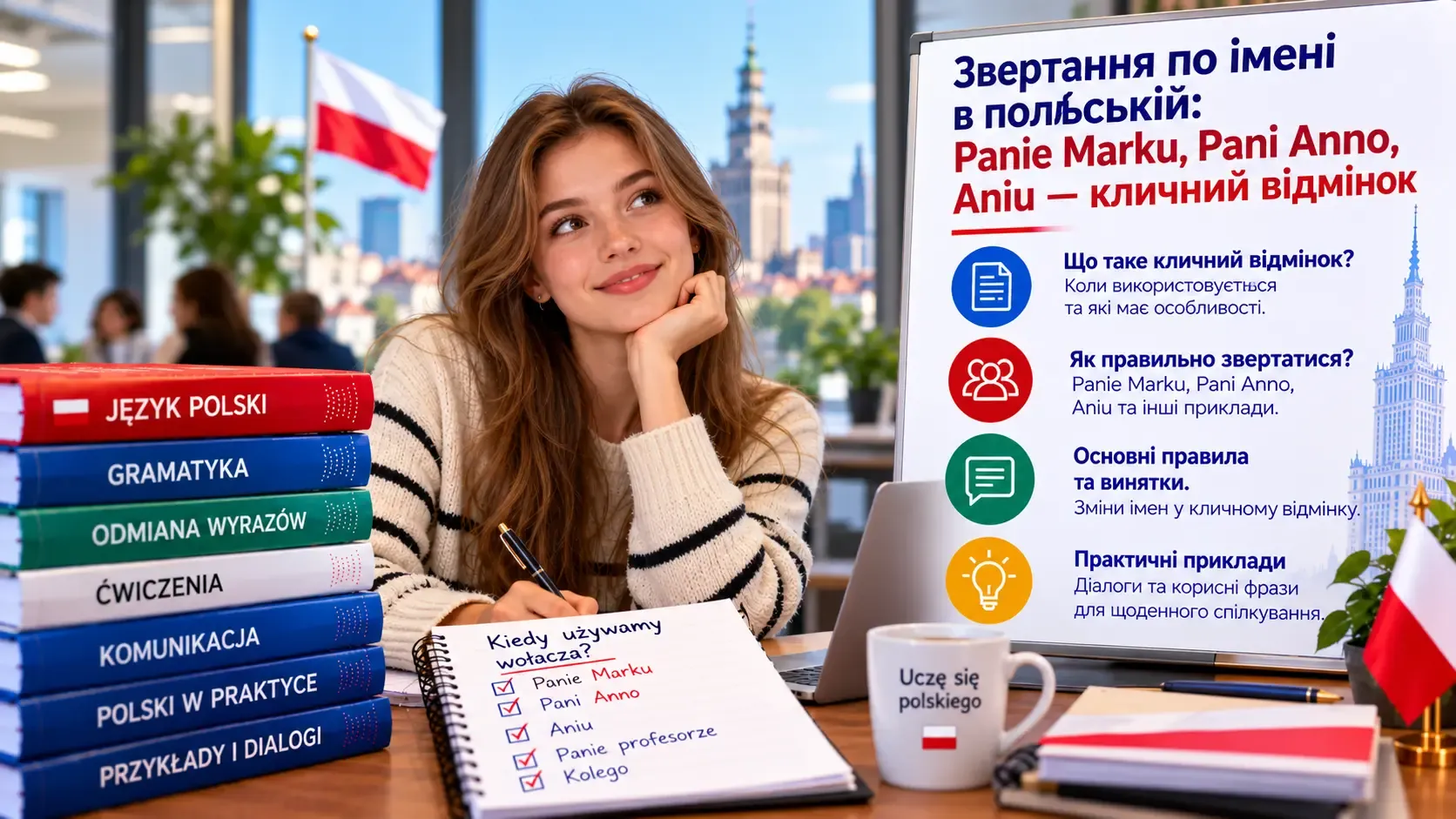

Poles are very attentive to forms of address. Your first day at a new job: you walk into the manager's office and say "Dzień dobry, Marek". For a Pole this sounds at least surprising. The right form is Dzień dobry, panie Marku, and here a special case comes into play that English does not have — the vocative. Let us look at how its forms are made, how to decline names in conversation and when diminutives are appropriate.
The vocative (wołacz)
The vocative is used when we address a person directly. Forms for different names and words are made by the following scheme:
- Feminine words in -a: instead of -a we write -o: mama → mamo, Anna → Anno, koleżanka → koleżanko.
- Feminine names in -ia (diminutives): -ia → -iu: Ania → Aniu, Kasia → Kasiu, Marysia → Marysiu.
- Masculine words in -ek: -ek → -ku: Marek → Marku, Jacek → Jacku, Piotrek → Piotrku.
- Most other masculine words: add -ie or -u: Jan → Janie, Adam → Adamie, Piotr → Piotrze, Tomasz → Tomaszu.
- Masculine words in -a: -a → -o: kolega → kolego, kierowca → kierowco.
- "Mr" and "Mrs": pan → panie, pani → pani (does not change), Państwo → Państwo.
Pan and pani + name
A polite address consists of pan / pani and a name or job title in the vocative:
- Dzień dobry, panie Marku. — Good morning, Mr Marek.
- Dzień dobry, pani Anno. — Good morning, Mrs Anna.
- Panie kierowniku, mam pytanie. — Mr Manager, I have a question.
- Pani dyrektor, dziękuję bardzo. — Madam Director, thank you very much.
- Szefie, czy mogę wyjść wcześniej? — Boss, may I leave early?
With a surname the nominative is more often kept: panie Kowalski, pani Nowak. With a series of job titles, the vocative: panie dyrektorze, pani kierowniczko.
In speech: the nominative instead of the vocative
Modern Poles in informal conversation often say Cześć, Marek instead of "Cześć, Marku". This is no longer considered a gross mistake, but in a polite tone, in letters and with superiors the vocative is expected. Until you get used to it, it is better to use the form panie Marku, pani Anno.
Letters and messages
- Szanowny Panie Marku, — Dear Mr Marek,
- Szanowna Pani Anno, — Dear Mrs Anna,
- Szanowni Państwo, — Dear Sir and Madam (for a group).
- Z poważaniem, Taras Kowal — Yours sincerely, Taras Kowal.
The salutation in a letter is capitalised and ends with a comma; the next sentence begins in lower case.
Declining names in speech
Ukrainian names in Polish also change by case. Useful models:
- Taras: Tarasa (genitive), Tarasowi (dative), Tarasa (accusative), z Tarasem (instrumental), o Tarasie (locative).
- Iryna: Iryny, Irynie, Irynę, z Iryną, o Irynie.
- Oleksij: Oleksija, Oleksijowi, Oleksija, z Oleksijem, o Oleksiju.
- Marek: Marka, Markowi, Marka, z Markiem, o Marku.
Examples: Dzwonię do Tarasa. Rozmawiałem z Iryną. Widzę Marka. Myślę o Oleksiju.
Diminutives (zdrobnienia)
Poles readily use diminutives — in conversation with friends, children and colleagues with whom warm relations have developed: Anna → Ania, Katarzyna → Kasia, Marek → Mareczek, kawa → kawka, herbata → herbatka, chwila → chwilka. The endings: -ka, -ek, -ko, -ik. In a formal situation (a boss, a client, a public office) they are better avoided: Poproszę kawę sounds businesslike, while Poproszę kawkę sounds friendly.
Useful phrases for getting acquainted
- Mam na imię Taras. — My name is Taras.
- Jak się pan nazywa? — What's your name?
- Miło mi pana poznać. — Nice to meet you.
- Proszę mówić mi po imieniu. — Please call me by my first name.
- Czy możemy przejść na ty? — May we switch to the informal "you"?
The first days: whom to address and how
In Polish companies there is a simple convention: managers and clients are addressed as "pan" or "pani", and colleagues in the crew usually by first name. If you are not sure, just ask: Jak mam się do pana zwracać? ("How should I address you?"). Such politeness never hurts, and many Poles appreciate that you took a moment for the right form. Later your boss may suggest switching to first names: Mów mi po imieniu.
A dialogue with a new colleague
- — Cześć, jestem Taras. Miło mi. — Hi, I'm Taras. Nice to meet you.
- — Marek. Mów mi Marku, jesteśmy w jednej brygadzie. — Marek. Call me Marek, we're in the same crew.
- — Dobrze, Marku. A szef? Jak się do niego zwracać? — OK, Marek. And the boss? How do I address him?
- — Pan Paweł. Mówimy „panie Pawle”. — Mr Paweł. We say "panie Pawle".
Three typical mistakes
- "Dzień dobry, Marek". To a manager the right form is: Dzień dobry, panie Marku.
- "Pani Anna!" as a direct address. Correct: Pani Anno!
- "Dzwonię do Taras". Correct: Dzwonię do Tarasa. After do — the genitive.
Practice
Put the address in the vocative.
- Dzień dobry, pan ___ (Marek).
- Dzień dobry, pani ___ (Anna).
- Dziękuję, ___ (mama).
- Pan ___ (dyrektor), mam pytanie.
- Cześć, ___ (Kasia).
- Dzwonię do ___ (Taras).
- Rozmawiam z ___ (Iryna).
- Szanowny ___ (pan) Janie,
Answers: 1 — Marku; 2 — Anno; 3 — mamo; 4 — dyrektorze; 5 — Kasiu; 6 — Tarasa; 7 — Iryną; 8 — Panie.
Summary
For a polite address remember the scheme: pan / pani + a name in the vocative (panie Marku, pani Anno), in letters Szanowny Panie, and among friends diminutives. Names in speech decline by the general rules. This will help you make a good impression from the first minutes in a new place.
Subscribe to our newsletter:
Latest Posts:
Latest Posts:
Personal pronouns in Polish: go or jego, cię or ciebie, do niego, z nią
Verbs and their cases in Polish: szukam pracy, pomagam koledze, czekam na autobus
Comparatives and superlatives in Polish: lepszy, tańszy, najlepszy, im więcej — tym więcej
Citizenship and permanent residence in Poland 2026: what has and has not changed