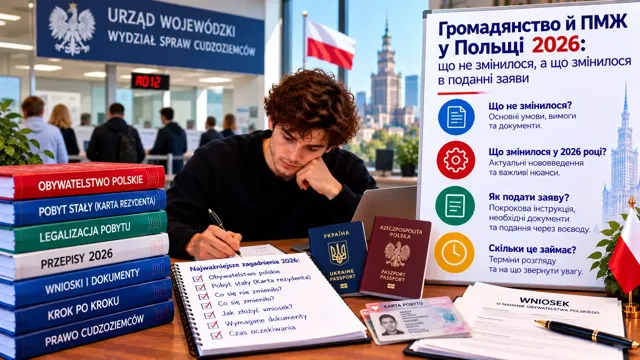
Polish language rules: 8 things worth knowing from day one


Some believe Polish is easy for speakers of other Slavic languages, so the rules can be skipped — everything is clear from context. That's not so. Similarity helps in the first weeks and then starts getting in the way: words sound familiar but mean something else, and habitual endings produce grammar mistakes a Pole hears instantly. For English speakers the alphabet alone looks scary — but the rules are more regular than English spelling.
1. Stress almost always falls on the second-to-last syllable
The simplest and most useful rule: Warszawa, pracować, dziękuję. There are exceptions (some past tense forms, for example), but "second-to-last syllable" instantly makes your pronunciation sound more natural.
2. Letter pairs are read as one sound
- cz — like "ch" in "church": czas, człowiek;
- sz — like "sh": szkoła, szafa;
- rz and ż — like "s" in "pleasure": rzeka, żona;
- ch and h — like "h" in "house", but harsher: chleb, herbata;
- ó — like "u": ósmy, góra.
3. Nasal ą and ę
Ą sounds roughly like "on", ę like "en". At the end of a word ę is often barely heard: "idę" sounds closer to "ide". Before "b" and "p" the nasals turn into "m": ząb sounds like "zomp".
4. Seven cases
Polish nouns change their endings depending on their role in the sentence — there are seven cases. One trap worth learning early: after negation the accusative turns into the genitive — mam samochód ("I have a car"), but nie mam samochodu ("I don't have a car").
5. Verb aspects
Most verbs come in pairs: imperfective for a process, perfective for a result. Robiłem zadanie — "I was doing the task", zrobiłem zadanie — "I did it". At work this matters: "sprawdzałem" doesn't mean you finished checking.
6. Pan and Pani instead of "you"
Strangers and colleagues are addressed in the third person: Czy pan może…?, Czy pani wie…? For a group — Państwo. Using "ty" without being invited sounds overfamiliar.
7. The masculine-personal form
In the past tense plural there are two forms: byli — when the group includes at least one man, były — for women, animals and things. "Pracownicy byli", but "dziewczyny były".
8. False friends
- ewentualnie — "possibly / alternatively", not "eventually";
- aktualnie — "currently", not "actually";
- konkurs — "competition", not "concourse";
- dywan — "carpet", not "divan";
- pensja — "salary", not "pension".
Checklist for the first weeks
- Pronunciation. Read 10 words with cz, sz and rz aloud every day.
- Stress. Check every new word for the second-to-last syllable.
- Addressing people. Learn 5 phrases with Pan, Pani and Państwo for work.
- Trap list. Write down every false friend you meet.
- Practice. Our free Polish lessons are in the "Learning Polish" section.
Subscribe to our newsletter:
Latest Posts:
Latest Posts:
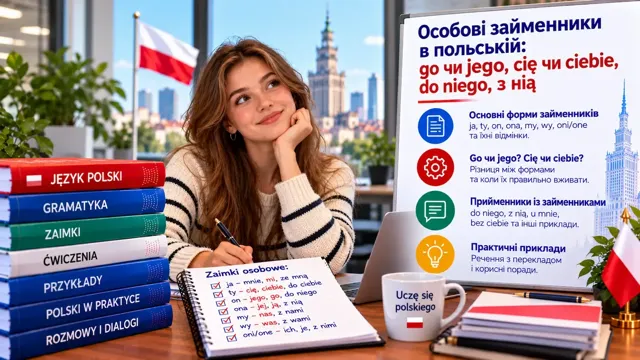
Personal pronouns in Polish: go or jego, cię or ciebie, do niego, z nią
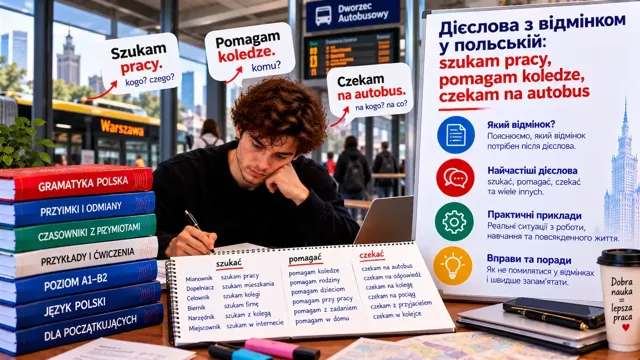
Verbs and their cases in Polish: szukam pracy, pomagam koledze, czekam na autobus
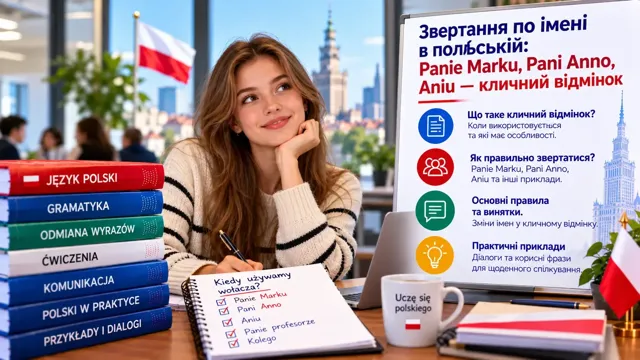
Addressing people in Polish: Panie Marku, Pani Anno, Aniu — the vocative
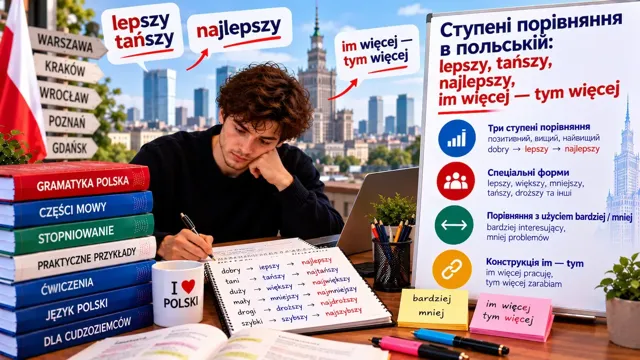
Comparatives and superlatives in Polish: lepszy, tańszy, najlepszy, im więcej — tym więcej