Where is the pallet? Polish prepositions of position: przed, za, pod, nad, między, obok
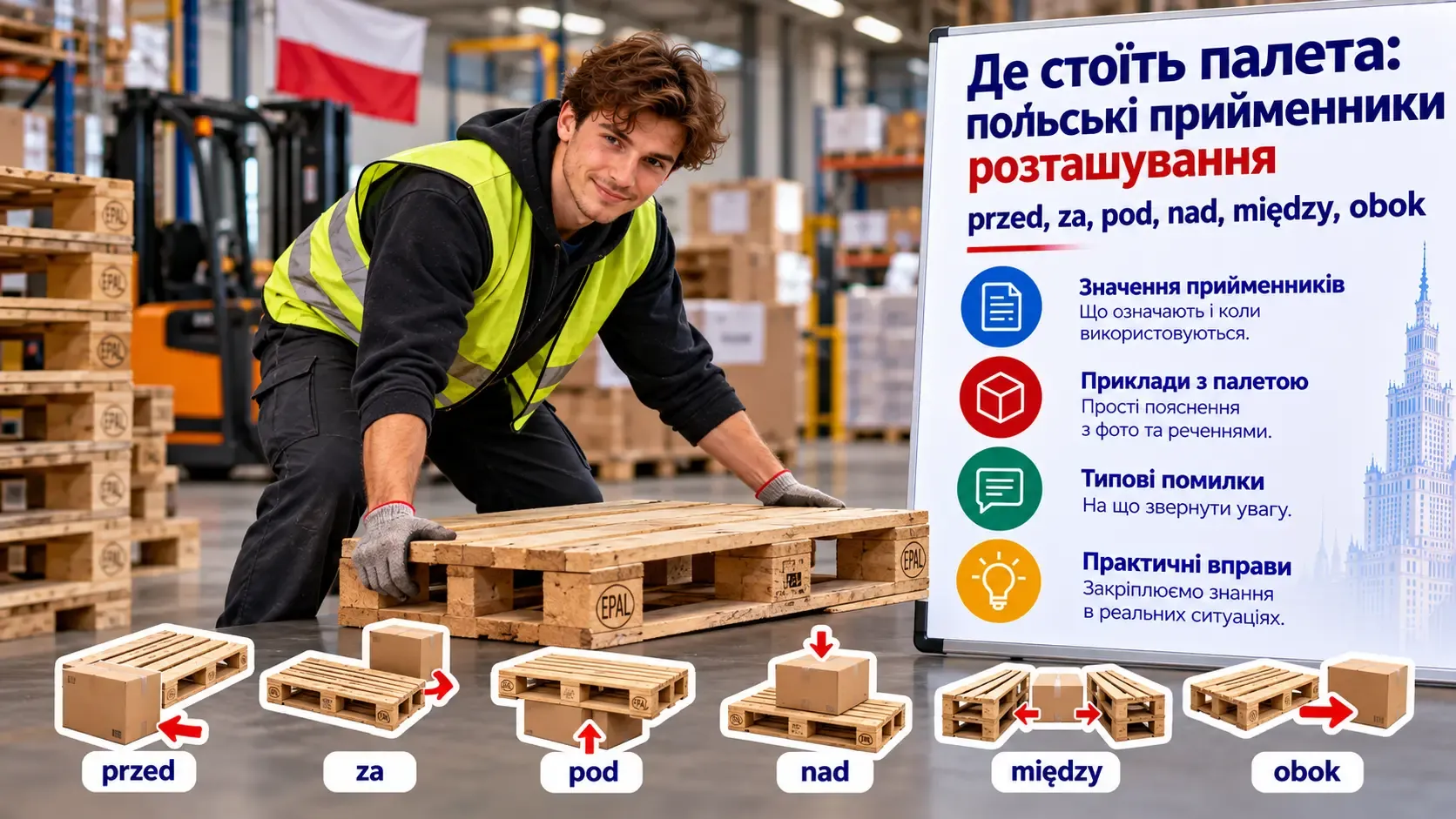

In a warehouse, on a building site or in an ordinary shop you sooner or later have to explain where something is: "the pallet is behind the gate", "the keys are under the table", "we'll meet near the entrance". The English equivalents look obvious, but in Polish each preposition takes its own case, and it is the ending that gives away that someone learned the language by ear. Below we sort it all out: which prepositions take the instrumental, which the genitive, and how not to confuse "where?" with "where to?".
A word in advance: this rule is entirely different from the w / na topic. That one was about choosing between an enclosed and an open space; this one is about the position of objects relative to one another.
Group 1: prepositions with the instrumental (narzędnik)
This group answers "where exactly?" and requires instrumental endings: -em for masculine and neuter, -ą for feminine.
- przed — in front of: przed domem, przed bramą, przed magazynem.
- za — behind: za budynkiem, za drzwiami, za rogiem.
- pod — under: pod stołem, pod oknem, pod ścianą.
- nad — above, over: nad rzeką, nad głową, nad regałem.
- między — between: między oknem a drzwiami, między regałami. Note that "a" stands in the place of "and" before the second noun.
Examples from real life: Paleta stoi przed bramą. Wózek jest za budynkiem. Skrzynka leży pod stołem. Lampa wisi nad stanowiskiem. Stoję między regałami i szukam kodu.
Group 2: prepositions with the genitive (dopełniacz)
Prepositions meaning closeness or "opposite" take the genitive:
- obok — next to: obok domu, obok regału.
- koło — near: koło szkoły, koło przystanku.
- blisko — close to: blisko dworca, blisko pracy.
- naprzeciwko — opposite: naprzeciwko sklepu, naprzeciwko wejścia.
- wokół — around: wokół budynku, wokół stołu.
- u — at someone's place: u lekarza, u szefa, u mnie w domu.
Genitive endings: masculine -a or -u (dom → domu, regał → regału), feminine -y or -i (brama → bramy, szkoła → szkoły), neuter -a (okno → okna).
Group 3: przy with the locative
Przy means "by, at" and takes the locative: przy drzwiach, przy maszynie, przy stole, przy kasie. The difference from obok is subtle: obok is simply next to, przy is right at the spot of the action. That is why we say pracuję przy maszynie (I work at the machine) and stoję przy kasie.
Where and where to: the same pair as with w / na
With pod, nad, przed, za and between an important change applies: when there is movement or direction, the noun is in the accusative (biernik), not the instrumental. Compare:
- Where? Stoję pod domem. (instrumental) — Where to? Idę pod dom. (accusative)
- Where? Skrzynka leży pod stołem. — Where to? Wkładam skrzynkę pod stół.
- Where? Samochód stoi za budynkiem. — Where to? Wjeżdżam za budynek.
- Where? Lampa wisi nad stołem. — Where to? Wieszam lampę nad stół.
For inanimate masculine nouns the accusative usually looks like the nominative: pod stół; for feminine nouns -ę appears: pod ścianę, za bramę.
A mini-glossary for work
Here are some workplace constructions you will use all the time.
- Zostaw paletę przed bramą. — Leave the pallet in front of the gate.
- Kierowca czeka za magazynem. — The driver is waiting behind the warehouse.
- Kask leży pod ławką. — The helmet is under the bench.
- Proszę stanąć obok regału. — Please stand next to the rack.
- Biuro jest naprzeciwko wejścia. — The office is opposite the entrance.
- Pracuję przy taśmie. — I work at the conveyor.
- Zadzwoń do mnie, kiedy będziesz blisko dworca. — Call me when you are near the station.
A mini-dialogue in the warehouse
Here is how it all sounds together in a short exchange between two colleagues.
- — Gdzie jest wózek? — Where is the truck?
- — Stoi za magazynem, obok bramy. — It's behind the warehouse, next to the gate.
- — A paleta z kartonami? — And the pallet of boxes?
- — Leży przed bramą, pod daszkiem. Zawieź ją do hali, między regały. — It's in front of the gate, under the canopy. Take it into the hall, between the racks.
Notice that one short dialogue contains all three groups of prepositions and even the accusative of movement (do hali, między regały).
Three typical mistakes
- Genitive instead of instrumental: "przed domu". Correct: przed domem. After przed, za, pod, nad comes the instrumental.
- Instrumental instead of genitive: "obok domem". Correct: obok domu. After obok, koło, blisko comes the genitive.
- The case with movement: "wkładam pod stołem". Correct: wkładam pod stół. If there is movement, you need the accusative.
Practice: put the word in the right form
Try to fill in the gaps, putting the word in brackets in the correct case.
- Paleta stoi przed ___ (brama).
- Telefon leży pod ___ (stół).
- Sklep jest obok ___ (szkoła).
- Pracuję przy ___ (maszyna).
- Lampa wisi nad ___ (biurko).
- Czekam naprzeciwko ___ (dworzec).
- Wkładam kartony pod ___ (ściana).
- Mieszkam blisko ___ (praca).
Answers: 1 — przed bramą; 2 — pod stołem; 3 — obok szkoły; 4 — przy maszynie; 5 — nad biurkiem; 6 — naprzeciwko dworca; 7 — pod ścianę (movement); 8 — blisko pracy.
How not to mix up the groups
Remember a simple scheme: "over, under, in front of, behind, between" take the instrumental, "next to, near, around, opposite" take the genitive, and przy takes the locative. When you think about movement there is one change: the instrumental becomes the accusative. And one more tip: learn a preposition together with an example, not on its own. The phrase "Paleta stoi przed bramą" will stick better than a table of three columns.
Subscribe to our newsletter:
Latest Posts:

More in this section: Polish grammar rules in plain words

W or na in Polish: how to choose the right preposition of place (w pracy, na budowie)

Adjectives in Polish: dobry, dobra, dobre, dobrzy — gender, number and case in one scheme

Personal pronouns in Polish: go or jego, cię or ciebie, do niego, z nią