Recognising a school certificate or diploma in Poland: when you need nostrification
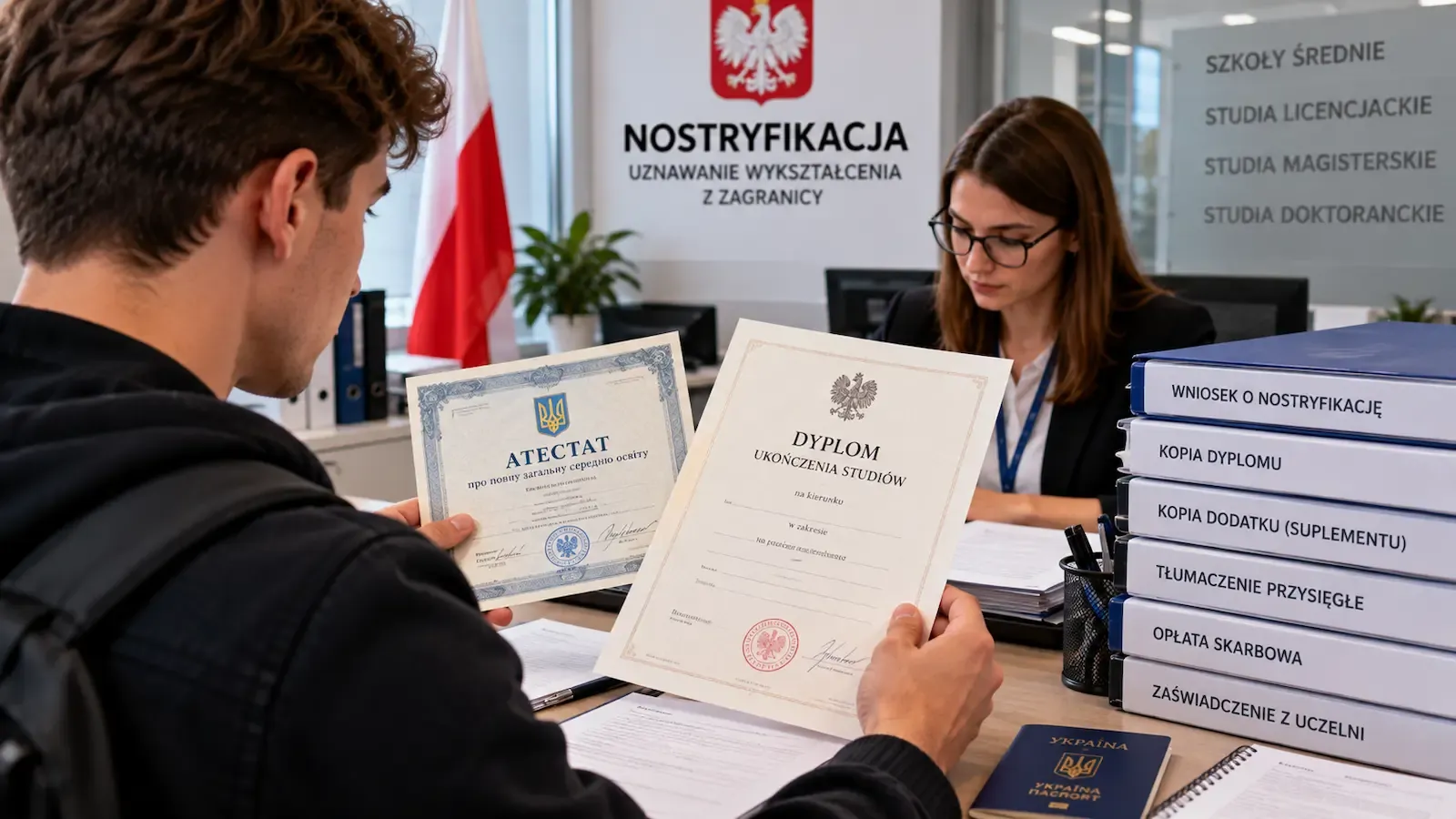

"Without nostrification they won't take you for studies or for work," Iryna was told in a migrants' group. She was already bracing for months of paperwork and translation costs. Then at a university admissions office in Wrocław she heard: "You don't need nostrification — bring your school certificate with an apostille and a translation."
The word "nostrification" scares people precisely because it's used for everything. In fact Poland has several different procedures: recognising a school certificate for admission, recognising a diploma for further study, recognising a diploma for work, and separate rules for regulated professions. Many people don't need nostrification at all — but you have to find out for your particular document.
A school certificate for university admission
To enter a first-cycle programme, your school certificate must give the right to higher education in the country that issued it. Polish law recognises some foreign certificates automatically — including those from EU, OECD and EFTA countries and countries with which Poland has relevant agreements, as well as international baccalaureates (IB, EB). Other documents need nostrification by the education superintendent (kurator oświaty).
- What's usually needed. The original certificate, an apostille or legalisation, and a sworn Polish translation.
- Who decides. Ultimately the university, when it accepts your documents. The simplest thing is to write to admissions and ask about your document.
- Certificates from Ukraine. Separate arrangements apply — check the current rules with the university and on the NAWA website, as they have changed.
A diploma for a master's or doctorate
If you want to start a master's with a foreign bachelor's degree, the university you apply to decides. It assesses whether your diploma corresponds to a Polish first-cycle degree. Separate nostrification usually isn't needed for this — but the university may ask for extra documents: the diploma supplement listing subjects and hours, the curriculum.
A diploma for work
- Non-regulated professions. For most jobs — in business, IT, trade, logistics — the employer decides whether your diploma is enough. Official recognition isn't mandatory, though a certificate of education level can help.
- Regulated professions. Doctor, nurse, pharmacist, teacher, architect, lawyer — these require separate qualification recognition procedures, often with exams and internships. Ordinary nostrification doesn't replace them.
- Civil service. Working in state institutions involves stricter recognition requirements.
How diploma nostrification works
If you do need your diploma nostrified (e.g. an employer or institution requires a Polish equivalent), it's done by a Polish university authorised to award degrees in the relevant field. The procedure:
- Choose a university with the relevant programme.
- Application with your diploma, supplement, apostille and translations.
- Programme assessment — the university compares your studies with the Polish one.
- Decision — recognition, recognition on condition of passing extra subjects, or refusal.
Nostrification is paid, and the fee is set by the university within legal limits. It takes several months.
The role of NAWA
The Polish National Agency for Academic Exchange (NAWA) is the main source of information on recognising foreign education in Poland. On its website you can check whether nostrification is needed for your country and get a statement on a foreign diploma — a document describing your diploma and its level. For many employers that's enough.
Transferring from a foreign university
Separate from nostrification, there's recognition of study periods if you want to transfer to a Polish university in your second or third year. The university compares your subjects with its programme and decides which semester to admit you to and which differences you need to make up. This, too, happens without nostrification — through the dean's office of your chosen programme.
The most common mistakes
- Nostrification "just in case". People spend money and time on a procedure they don't need.
- No diploma supplement. A university can't assess a programme without a list of subjects and hours.
- An ordinary translation. You need a sworn translator, not an agency without a tłumacz przysięgły stamp.
- Regulated profession. Expecting that nostrifying a medical diploma lets you work as a doctor straight away.
Checklist: what to do with your education documents
- Purpose. Decide what the document is for: admission, master's, work, regulated profession.
- NAWA. Check the rules for your country on its website.
- University. Ask admissions about your specific document.
- Apostille. Get it in the country that issued the document.
- Translation. Only from a sworn translator.
- Supplement. Get the diploma supplement with subjects and hours.
Subscribe to our newsletter:
Latest Posts:
Latest Posts:

Personal pronouns in Polish: go or jego, cię or ciebie, do niego, z nią
Verbs and their cases in Polish: szukam pracy, pomagam koledze, czekam na autobus

Addressing people in Polish: Panie Marku, Pani Anno, Aniu — the vocative
Comparatives and superlatives in Polish: lepszy, tańszy, najlepszy, im więcej — tym więcej