Part-time study and shift work in Poland: how not to drop out in semester two
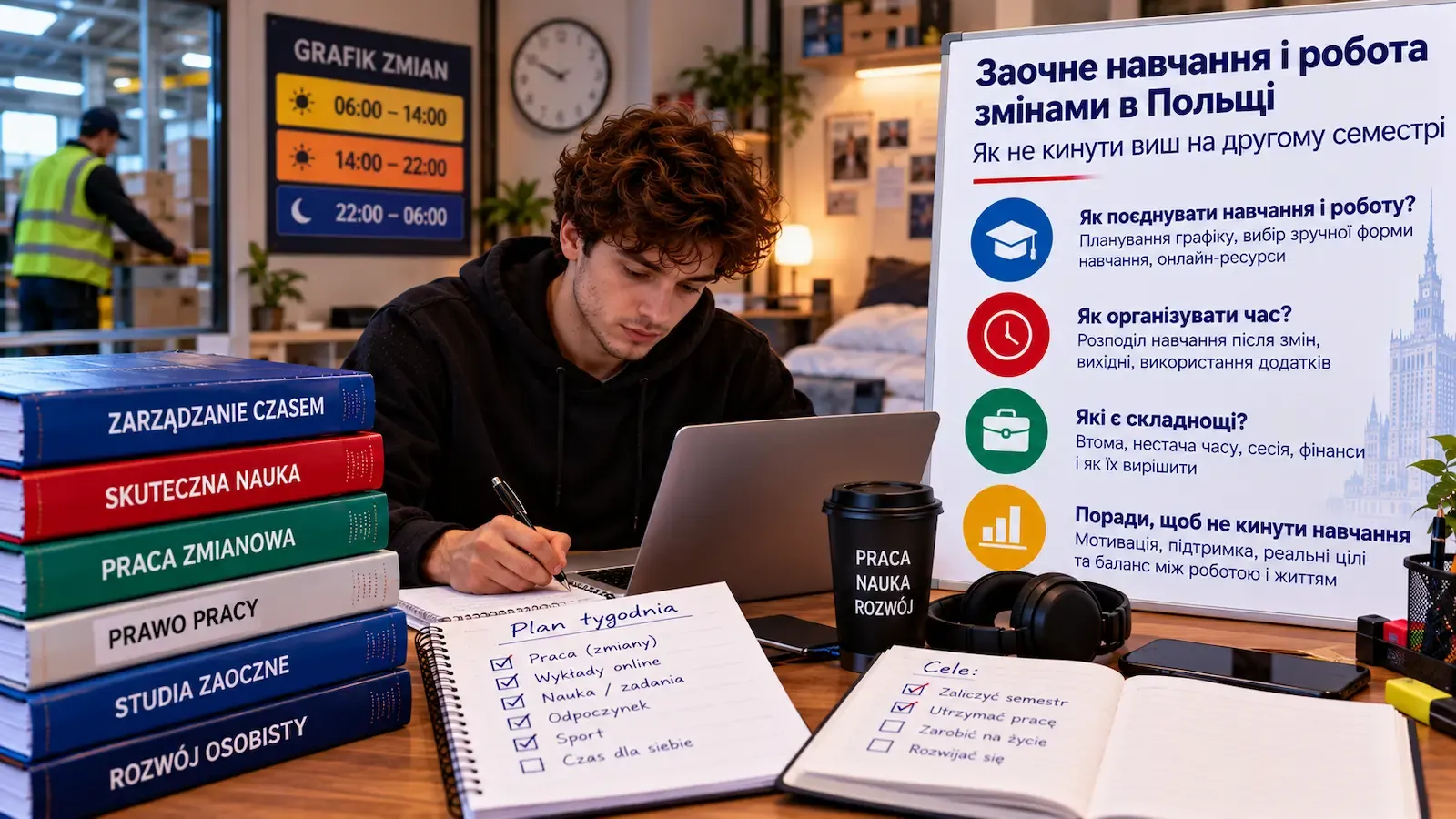

Taras got through his first semester on enthusiasm: weekend sessions every two weeks, Saturdays and Sundays in lecture halls, and on Monday at six — a warehouse shift. In November it all held together. In January exams arrived, his supervisor rostered him for two Saturdays in a row, and Taras missed both tests. He didn't come back for semester two.
A common belief is that part-time study (studia niestacjonarne) "naturally" fits around work because classes are at weekends. In fact it only fits when it's planned: the session schedule, an arrangement with your employer, slack for exams. Without that, the first scheduling clash ends in a leave of absence — or being struck off.
What part-time study looks like
- Sessions. Usually every 2 weeks, Saturday and Sunday from morning to evening. Some universities hold part of the classes online or on Friday evenings.
- Exams. Exams and tests come at the end of the semester, often at weekends too. Resits have separate dates that are easy to miss.
- Self-study. Coursework, projects and reading between sessions — this takes a few hours a week.
- Fees. At private universities part-time study is paid, and you should know the total for the whole programme, not just the first year.
Step 1. Get the schedule before signing
Most private universities publish the harmonogram zjazdów for the whole semester before it starts. Ask for it before signing the study agreement. Check how many sessions there are, whether there are Friday classes, when the exams are. Compare it with your work schedule: if Saturday shifts are the norm at your company, solve that before enrolling, not after.
Step 2. Talk to your employer
Ideally openly, with dates in hand. Show the session schedule and suggest options:
- Fixed days off. Ask not to be rostered on session days.
- Shift swaps. Agree with colleagues to take their weekdays in exchange for your Saturdays.
- Exam leave. Plan a few days of holiday for exams in advance.
- In writing. If the arrangement matters, ask for confirmation at least by email.
Many employers view study positively, especially if the field relates to the job: logistics, management, BHP.
Step 3. Urlop szkoleniowy — when you're entitled
The Labour Code provides training leave, but only when the employer has agreed to your studies as professional development (usually through a written agreement or referral). Then you can get:
- Paid days to prepare for exams — the number depends on the type of exam.
- Up to 21 days in the final year — to prepare your thesis and final exam.
- Time off work for classes that overlap with working hours.
If you study "for yourself", without your employer's agreement, these rights don't apply — you're left with ordinary holiday and negotiation.
Student status: what it gives and what it doesn't
- Under 26. On umowa zlecenie a student under 26 pays no ZUS contributions — and this applies to part-time students too.
- Discounts. A student ID gives travel discounts, but not for all students or all types of transport — check the rules of your city and carrier.
- Residence card. A study-based residence card requires full-time (stacjonarne) studies. Part-time study doesn't provide that basis — your legal stay must rest on work or another ground.
How not to burn out before the semester ends
Most people drop out not because it's hard but because they're exhausted. A few simple rules: don't take overtime in the weeks before exams; set aside two evenings a week for an hour — that's enough for ongoing tasks; find someone in your group with the same schedule and share notes. And count not just tuition money but hours of sleep. If the semester still goes wrong, don't just disappear: write to the dean's office about urlop dziekański or an individual plan — it's better than being struck off with tuition debt.
Checklist before enrolling part-time
- Schedule. Get the harmonogram zjazdów for the whole semester.
- Work roster. Compare sessions with your shifts.
- Employer. Agree on Saturdays before classes start.
- Holiday. Keep days for exams.
- Legal stay. Remember part-time study doesn't give a residence card.
- Money. Know the full cost for all years.
Subscribe to our newsletter:
Latest Posts:
Latest Posts:

Personal pronouns in Polish: go or jego, cię or ciebie, do niego, z nią
Verbs and their cases in Polish: szukam pracy, pomagam koledze, czekam na autobus

Addressing people in Polish: Panie Marku, Pani Anno, Aniu — the vocative

Comparatives and superlatives in Polish: lepszy, tańszy, najlepszy, im więcej — tym więcej