How to check a Polish university and programme in the state register before paying
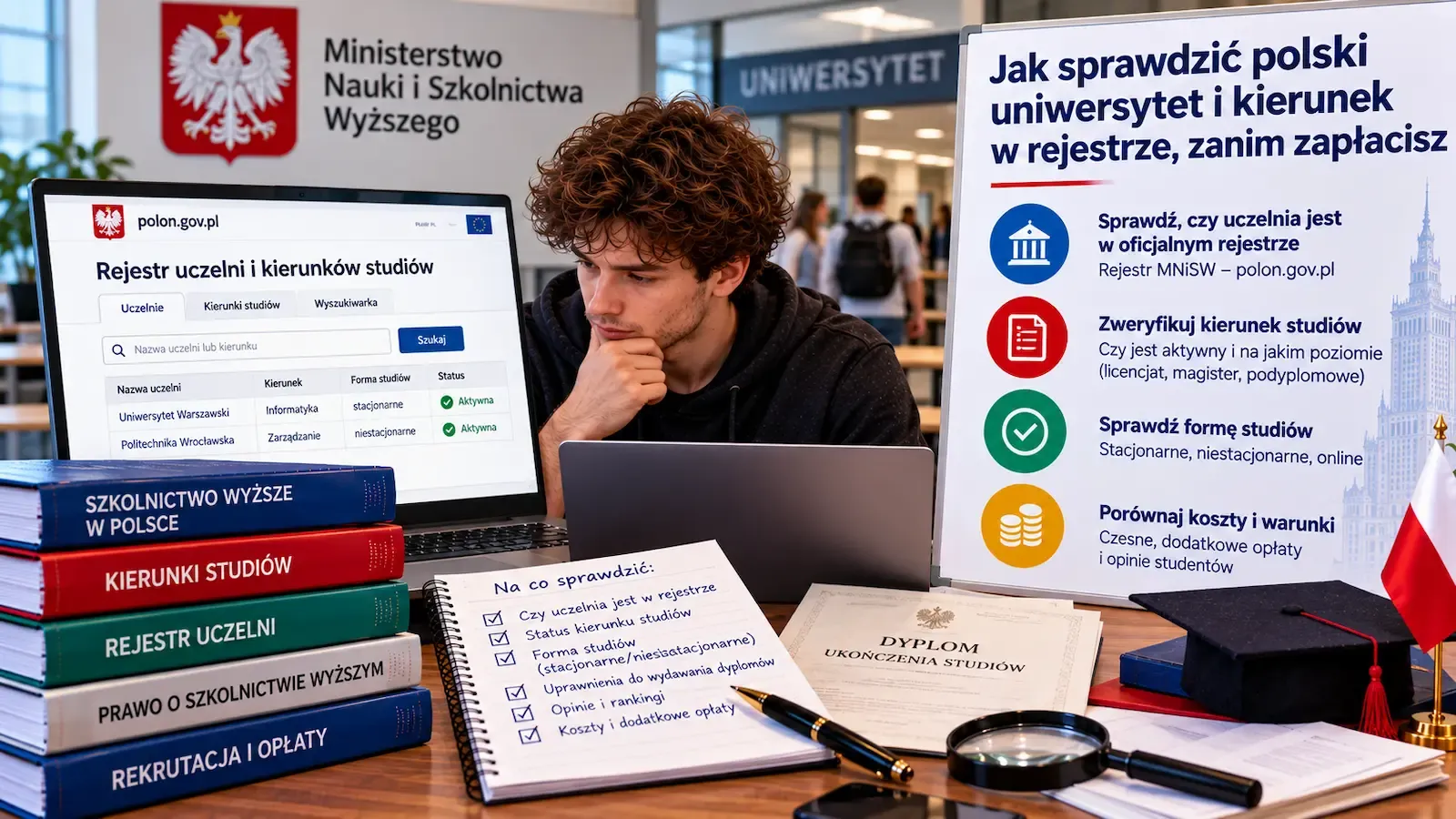

A beautiful website, "Akademia" in the name, photos of students in front of an old castle, and a manager on a messaging app promising "a European diploma in two years, no exams". There are many such offers aimed at foreigners online. Some are perfectly normal Polish private universities. Others are intermediaries selling places at universities of doubtful quality, or promising things the university has no right to give.
A common belief: if a university has a Polish website and an address in Poland, it's state-recognised. That's not true. You can check yourself, in public registers, whether an institution has the right to award a state-recognised diploma in a specific programme. It takes 15 minutes and can save you several thousand złoty and years of your life.
Step 1. Is the university in the state register
All Polish universities — public and private — are entered in the national higher education information system (POL-on / RAD-on), run by the ministry of science. It has a search by name.
- Full name. Search by the legal name from the contract, not the marketing one.
- Status. The university must be operating, not in liquidation.
- Type. Uczelnia akademicka or zawodowa — this determines which levels of study it may offer.
- Address. It should match where you'll actually attend classes. Branch campuses must be in the register too.
Step 2. Does it have the right to run your programme
Being called a "university" isn't enough. It must be authorised to run your specific programme (kierunek) at a given level and profile:
- Level. Licencjat or inżynier (first cycle), magister (second cycle) or jednolite magisterskie.
- Profile. Praktyczny or ogólnoakademicki.
- Mode. Full-time, part-time, online — check your mode is listed.
- Language. If you'll study in English, the English-taught programme must be listed as well.
If the programme isn't in the register, the university can't award a state-recognised diploma for it, whatever the ads promise.
Step 3. PKA quality assessment
The Polish Accreditation Committee (Polska Komisja Akredytacyjna) assesses teaching quality on programmes and publishes its ratings. A positive rating is a good sign. A negative one may mean the university loses the right to run the programme — then students have to transfer elsewhere. If a programme is new, there may be no rating yet — that's normal, but ask the university when accreditation is planned.
Warning signs
- "A diploma without studying". Promises of a shortened programme without credit transfer from previous studies.
- Payment to an intermediary. Money going not to the university's account but to an "agent's" card.
- No contract. A Polish university signs a written study agreement with the student (umowa o warunkach odpłatności).
- Clone name. A name very similar to a well-known public university.
- Visa guarantee. A visa is the consul's decision; no university can guarantee it.
Step 4. Read the study agreement
- Total cost. Per semester or year, and whether it can increase.
- Extra fees. Enrolment fee, diploma, resits, repeating a course.
- Refunds. What happens if you withdraw before classes start or after the first semester.
- Programme change. What happens if the programme doesn't get enough students.
What to ask the university before paying
Write to the admissions office and ask in writing for: the programme's register number, the mode and language of study, the total cost, and the first-semester timetable. A normal university will answer without difficulty. Evasive answers are a reason to keep looking.
If you've already paid and have doubts
Don't wait for classes to start. Check the register today and, if the programme isn't there, ask the university in writing to explain and refund the money under the contract. If the money went to an intermediary, keep the messages, receipts and advertising promises — you'll need them for a complaint to the police or a court. You can also report a university's dubious activity to the ministry of science. And remember: the sooner you notice, the better your chances of getting your money back and enrolling elsewhere the same year.
University check checklist
- Register. Find the university in POL-on / RAD-on by its legal name.
- Programme. Check the level, profile, mode and language.
- PKA. Look at the programme's quality rating.
- Money. Pay only into the university's account.
- Contract. Read the clauses on cost and refunds.
- In writing. Get key information from the university by email.
Subscribe to our newsletter:
Latest Posts:
Latest Posts:

Personal pronouns in Polish: go or jego, cię or ciebie, do niego, z nią

Verbs and their cases in Polish: szukam pracy, pomagam koledze, czekam na autobus

Addressing people in Polish: Panie Marku, Pani Anno, Aniu — the vocative

Comparatives and superlatives in Polish: lepszy, tańszy, najlepszy, im więcej — tym więcej