Opiekun medyczny in Poland: a year of study, an exam and where to work next
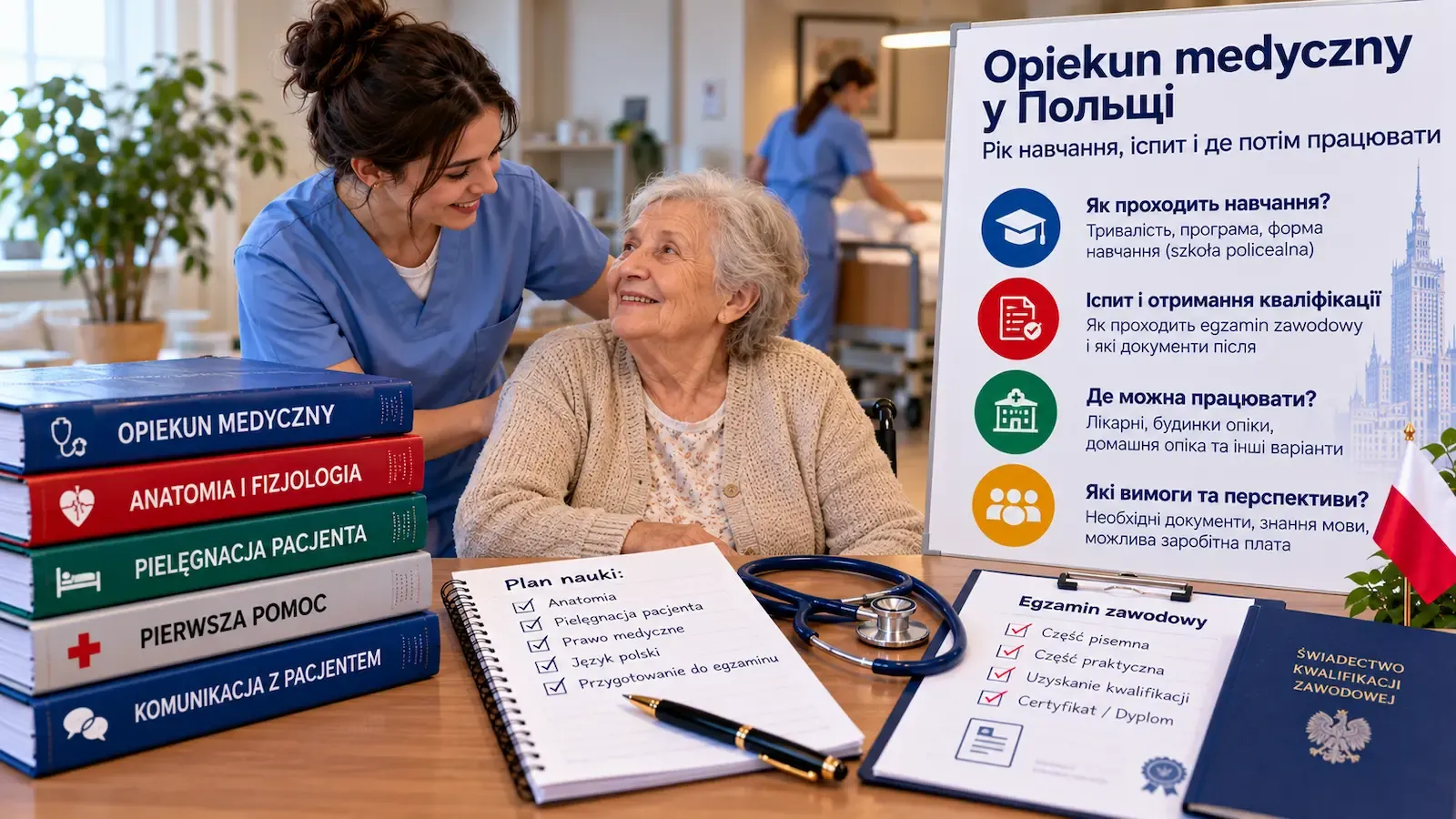
In Ukraine Lilia worked as a shop assistant; in Poland she packed boxes. After three years she realised two things: the production line was wearing her out, and she liked helping people — she'd cared for her grandmother and never felt it was a burden. A friend suggested a szkoła policealna course in opiekun medyczny. "A year of study, free, and there's always work," she said. That's almost true.
Many people think a carer in Poland is "just a care assistant" with a Polish name, and no training is needed. That isn't so. Opiekun medyczny is a separate profession with a state qualification, and hospitals and long-term care facilities hire people with the diploma for this role. Without it, what's left is mostly informal work in private homes.
What a medical carer does
- Hygiene and care. Helping patients who can't wash, dress, eat or change position in bed by themselves.
- Observation. Measuring blood pressure, temperature and pulse, monitoring the patient's condition and reporting changes to the nurse.
- Prevention. Preventing bedsores, helping with rehabilitation, supporting mobility.
- Support. Talking with the patient and family — in this job it matters as much as technical skills.
A carer doesn't perform the medical procedures reserved for nurses: no injections and no decisions about treatment. That's the main difference between the two professions.
How the course works
- Length. Usually 1 year — two semesters.
- Mode. Daytime or weekend (zaoczna) — classes on Saturday and Sunday roughly every two weeks. Weekend mode is popular with people who work.
- Cost. Public schools are free. Many non-public schools also charge nothing — they receive a subsidy but require regular attendance.
- Placement. A mandatory part of the programme — in hospitals, care facilities or hospices. That's often where people find their first employer.
Exam and qualification
The course ends with a state vocational exam organised by the regional examination board (OKE). The qualification is labelled MED.03. The exam has a written part — a test — and a practical part where you show your care skills. After passing you receive a qualification certificate and a diploma.
If it doesn't work out the first time, you can resit. For foreigners the hardest part is usually not the practical, but the medical vocabulary in the test, so work on your Polish from the first semester.
Requirements for foreigners
- Secondary education. You need a secondary school leaving certificate. A foreign certificate may need to be recognised in Poland — check with the school in advance.
- Polish. A formal certificate usually isn't required, but the course, placement and exam are in Polish. In practice you need a level at which you understand lectures and can talk with patients.
- Medical check. A certificate that you have no contraindications to working in the profession.
- Legal stay. The course itself doesn't always provide a basis for a residence card — check your situation.
Where to work after the diploma
- Hospitals — internal medicine, neurology, geriatrics, rehabilitation wards.
- ZOL and ZPO — long-term care facilities where patients stay for months.
- DPS — social care homes for elderly and disabled people.
- Hospices — residential and home-based.
- Private care companies — home care, including assignments in other EU countries.
Demand for carers in Poland is steady because the population is ageing. Starting pay is often close to the minimum wage, but it rises with experience, night shifts and weekend work. It's also worth understanding that the job is physically and emotionally demanding and doesn't suit everyone.
What comes after carer
For some people opiekun medyczny is a first step. Hospital experience helps you see whether you want to go further — for example, to study nursing at university or other medical courses at post-secondary schools. And the Polish medical vocabulary you pick up during a year of study and placements will be very useful later.
Checklist before enrolling
- Certificate. Ask the school whether your school certificate needs recognition.
- Mode. Choose weekend study if you work — and check the weekend schedule.
- Cost. Double-check that the course really is free and what the attendance rules are.
- Placement. Ask where exactly the school arranges placements.
- Polish. Start learning medical vocabulary before the first class.
- Reality check. Talk to people who already work as carers — it's the best test of your motivation.
Subscribe to our newsletter:
Latest Posts:
Latest Posts:
Personal pronouns in Polish: go or jego, cię or ciebie, do niego, z nią
Verbs and their cases in Polish: szukam pracy, pomagam koledze, czekam na autobus
Addressing people in Polish: Panie Marku, Pani Anno, Aniu — the vocative
Comparatives and superlatives in Polish: lepszy, tańszy, najlepszy, im więcej — tym więcej