
Polish exam B2: who needs it and how it differs from B1


Some believe B2 is "the same B1, just a bit harder". It isn't. At B2 you're expected not just to produce clear sentences but to argue: agree or disagree, compare options, write a text with a clear structure. People who passed B1 confidently often fail precisely the writing part of B2.
Who needs B2
- Studying in Polish — most public and private universities require B2 for Polish-taught programmes.
- Jobs with documents and customers — offices, administration, healthcare, education.
- Your own confidence — B2 means you easily understand news, contracts and official letters.
For citizenship and resident status B1 is enough, so B2 isn't required there.
How B2 differs from B1
- Longer, harder texts — journalism, interviews, fragments of official documents.
- Faster listening — natural pace, interruptions, several speakers.
- Finer grammar — adverbial participles, impersonal forms, the conditional, complex conjunctions.
- Argumentative writing — an essay, a complaint, an official letter with a clear position.
- Discussion-based speaking — state an opinion, defend it and answer counter-arguments.
The structure is the same: five parts, at least 50% in each.
The hardest tasks
- A 200–250-word essay — introduction, arguments, conclusion. Without structure you lose points even for a grammatically correct text.
- A formal complaint letter — tone and form must be right.
- Listening to a discussion — telling which participant claims what.
- Grammar transformations — rewriting a sentence with another construction without changing its meaning.
How long to prepare
Going from B1 to B2 usually takes 6–12 months of regular study. Writing takes the most time: it can't improve without feedback from a teacher. Group classes combined with individual text corrections work best.
What to read and listen to
- Polish news websites — 2–3 articles a day, noting new words.
- Podcasts and radio on social topics — natural speaking speed.
- Official letters from your bank, ZUS or the voivode's office — the best material for formal style.
Preparation checklist
- Diagnosis. Do a B2 sample test and see which part is weakest.
- Essay. One text a week, checked.
- Connectors. "po pierwsze", "z jednej strony", "niemniej jednak" — so your arguments sound natural.
- Listening. Materials without subtitles and with different voices.
- Speaking. Debates with a partner: 3 minutes for, 3 minutes against.
- Registration for a session 2–3 months in advance.
Subscribe to our newsletter:
Latest Posts:
Latest Posts:
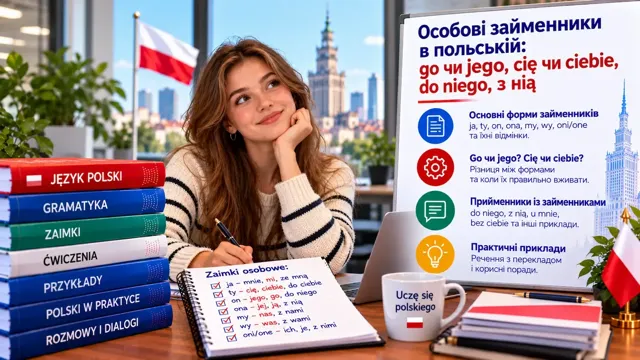
Personal pronouns in Polish: go or jego, cię or ciebie, do niego, z nią
The words "I", "you", "he" in Polish have many forms, and we most often see them not in th...
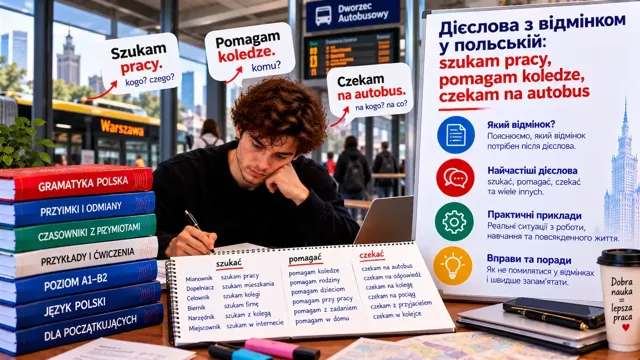
Verbs and their cases in Polish: szukam pracy, pomagam koledze, czekam na autobus
A learner of Polish quickly notices that words are similar but the cases after verbs are n...
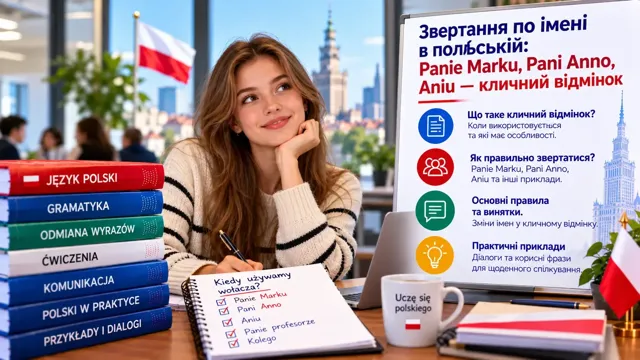
Addressing people in Polish: Panie Marku, Pani Anno, Aniu — the vocative
Poles are very attentive to forms of address. Your first day at a new job: you walk into t...
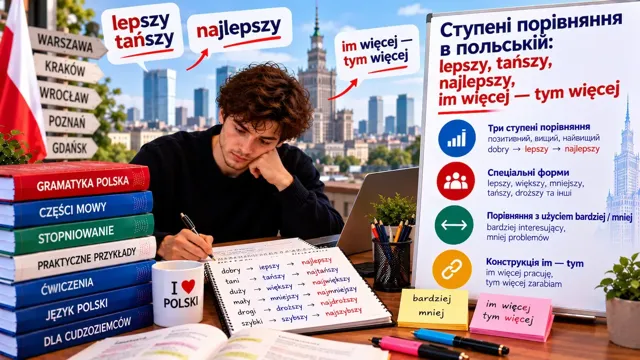
Comparatives and superlatives in Polish: lepszy, tańszy, najlepszy, im więcej — tym więcej
When looking for work we compare all the time: "a higher rate", "closer to home", "an easi...
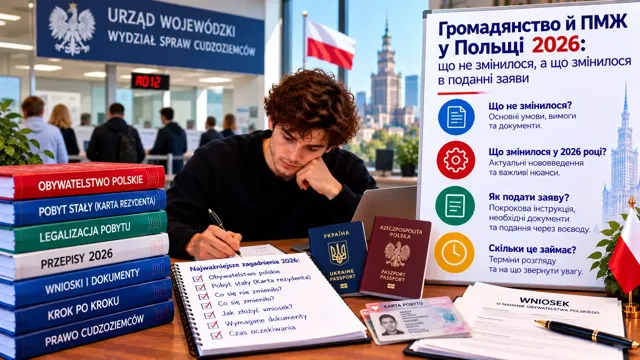
Citizenship and permanent residence in Poland 2026: what has and has not changed
In October 2026 rumours are going round again among foreigners in Poland: "citizenship wil...