Telling the time in Polish: która godzina, o której, od–do, w poniedziałek
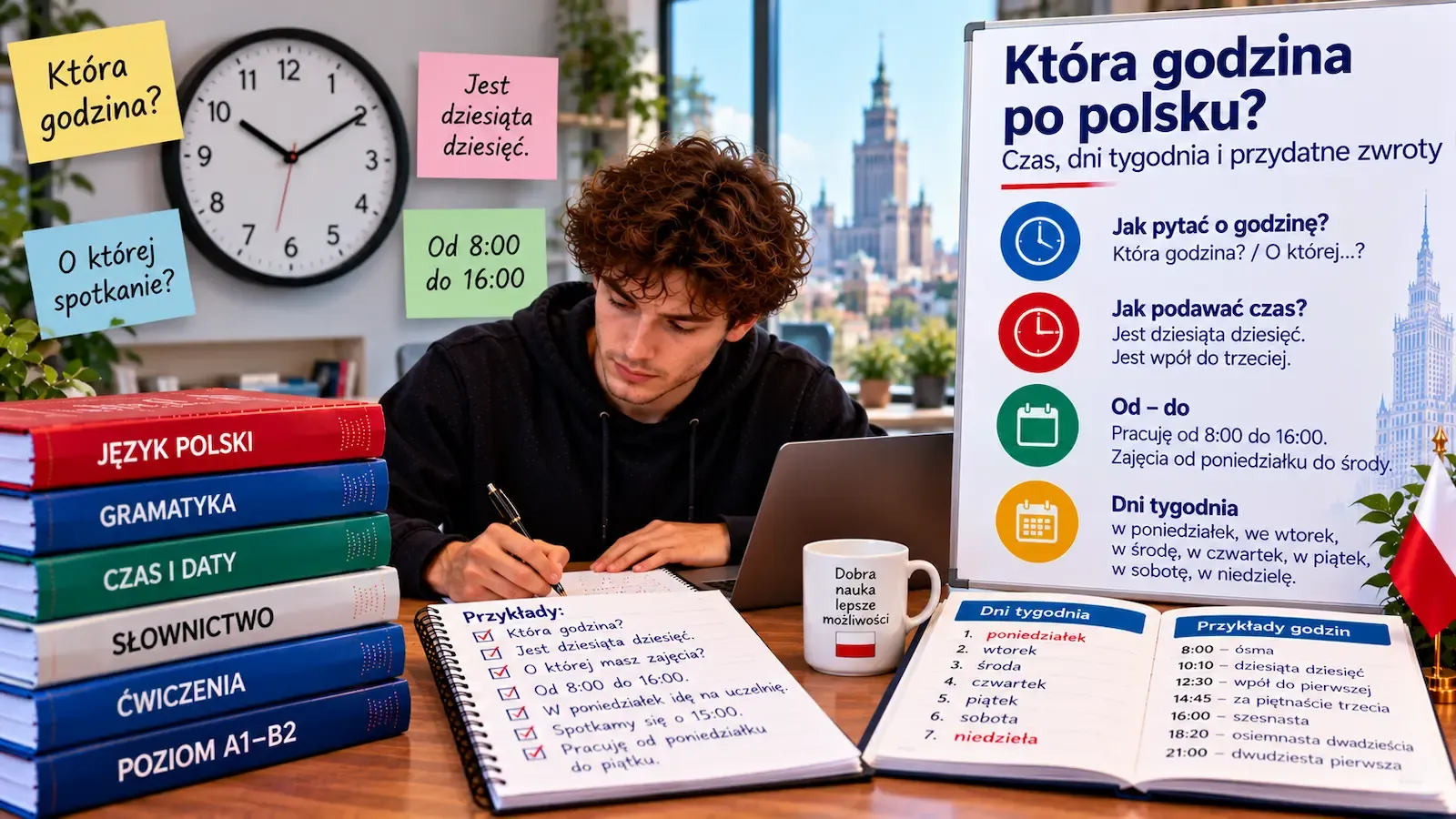

At an interview, in a shift schedule and even in a text from your manager you quickly find out that you have to read the clock in Polish. You are told "zaczynamy o szóstej", "koniec zmiany o czternastej trzydzieści", "od poniedziałku do piątku", and behind every phrase are its own endings. The good news is that there are few rules. Below we look at how to ask the time, how to say it in two ways (official and spoken) and how to say that you need Monday or from six to ten at night.
How to ask the time
- Która godzina? or Która jest godzina? — What time is it?
- Ile jest czasu? — the colloquial "what's the time".
- O której godzinie zaczynasz pracę? — What time do you start work?
- O której kończysz? — What time do you finish?
Note two words: która (feminine, because the noun is godzina) and której (the locative after the preposition o). It is the same "which" in different cases.
The answer: feminine ordinal numbers
Hour is a feminine word in Polish, so the numbers change: pierwsza, druga, trzecia, czwarta, piąta, szósta, siódma, ósma, dziewiąta, dziesiąta, jedenasta, dwunasta. When answering "Która godzina?" we use the nominative: Jest piąta. Jest wpół do ósmej. And for "O której?" the locative with the ending -ej: o piątej, o szóstej, o ósmej, o dwunastej.
Two ways to name the time
Official (24-hour) is used in schedules, announcements and at work: czternasta trzydzieści (14:30), dwudziesta druga (22:00), szósta piętnaście (6:15). It is clear and no one gets it wrong.
Spoken (12-hour) is used in everyday life, with "to" or "past":
- piętnaście po trzeciej or kwadrans po trzeciej — 3:15.
- wpół do czwartej — 3:30 (literally "half to four").
- za piętnaście czwarta or za kwadrans czwarta — 3:45.
- za dziesięć szósta — ten to six.
- dziesięć po piątej — 5:10.
Beware of "wpół do": it is a trap for English speakers, because wpół do trzeciej is 2:30, not 3:30. Slavic speakers know the construction from their own language ("half to three"), but it is still worth remembering.
From … to: shifts at work
For a span of time we use od + genitive and do + genitive: od szóstej do czternastej, od ósmej do szesnastej. Here is a typical shift schedule you will meet many times:
- Pierwsza zmiana: od szóstej do czternastej.
- Druga zmiana: od czternastej do dwudziestej drugiej.
- Trzecia zmiana: od dwudziestej drugiej do szóstej.
Days of the week
The names: poniedziałek, wtorek, środa, czwartek, piątek, sobota, niedziela. To answer "when?" we use w + accusative: w poniedziałek, we wtorek, w środę, w czwartek, w piątek, w sobotę, w niedzielę. Before "wtorek" an e is added for ease of pronunciation: we wtorek.
- W poniedziałek zaczynam o szóstej. — On Monday I start at six.
- We wtorek mam wolne. — On Tuesday I'm off.
- W sobotę pracuję do czternastej. — On Saturday I work until two p.m.
For a range of days: od poniedziałku do piątku (genitive). And for a habit — w poniedziałki (on Mondays) or co poniedziałek (every Monday).
Parts of the day
- rano — in the morning; w południe — at noon; po południu — in the afternoon; wieczorem — in the evening; w nocy — at night.
- zmiana poranna / popołudniowa / nocna — the morning, afternoon and night shift.
How often: co, raz, codziennie
- codziennie — every day; co tydzień — every week; co godzinę — every hour; co dwie godziny — every two hours.
- raz w tygodniu — once a week; dwa razy w miesiącu — twice a month.
- zawsze, często, czasem, rzadko, nigdy — always, often, sometimes, rarely, never.
How long: przez, za, temu
- przez dwie godziny — for two hours.
- za godzinę — in an hour (in the future).
- godzinę temu — an hour ago.
- od dwóch lat — for two years already.
Phrases about being late and breaks
For everyday situations on a shift, ready-made phrases are useful:
- Spóźnię się o dziesięć minut. — I'll be ten minutes late.
- Zaczynam za pięć minut. — I start in five minutes.
- Przerwa jest o dziewiątej. — The break is at nine.
- Czy mogę wyjść wcześniej? — May I leave earlier? (wcześniej — earlier, później — later).
- Do zobaczenia jutro o szóstej! — See you tomorrow at six!
A dialogue about the schedule
- — O której zaczynasz pracę w poniedziałek? — What time do you start on Monday?
- — O szóstej. A ty? — At six. And you?
- — Ja mam drugą zmianę, od czternastej do dwudziestej drugiej. — I have the second shift, from two to ten p.m.
- — Spotkamy się w sobotę wpół do trzeciej? — Shall we meet on Saturday at half past two?
Three typical mistakes
- "O szósta". Correct: o szóstej. After o the ordinal number is in the locative.
- "W wtorek". Correct: we wtorek.
- "Wpół do trzeciej" as 3:30. It is 2:30. Half past three is wpół do czwartej.
Practice
Say it in Polish using the form in brackets.
- Zaczynam pracę ___ (szósta).
- Pracuję od poniedziałku ___ piątku.
- ___ wtorek mam wolne.
- 2:30 colloquially: ___ do trzeciej.
- Koniec zmiany ___ czternastej trzydzieści.
- Spotykamy się ___ sobotę. (a day → accusative)
- Autobus jeździ ___ pół godziny.
- Pracuję ___ osiem godzin. (for)
Answers: 1 — o szóstej; 2 — do; 3 — We; 4 — wpół; 5 — o; 6 — w; 7 — co; 8 — przez.
Summary
Remember the scheme: Która godzina? — nominative, O której? — the locative with the ending -ej, od … do — the genitive, and w + a day — the accusative. In work schedules you will only need the 24-hour version, and that is the one to start with.
Subscribe to our newsletter:
Latest Posts:
Latest Posts:

Personal pronouns in Polish: go or jego, cię or ciebie, do niego, z nią
Verbs and their cases in Polish: szukam pracy, pomagam koledze, czekam na autobus

Addressing people in Polish: Panie Marku, Pani Anno, Aniu — the vocative
Comparatives and superlatives in Polish: lepszy, tańszy, najlepszy, im więcej — tym więcej