Iść or chodzić, jechać or jeździć: Polish verbs of motion without the confusion
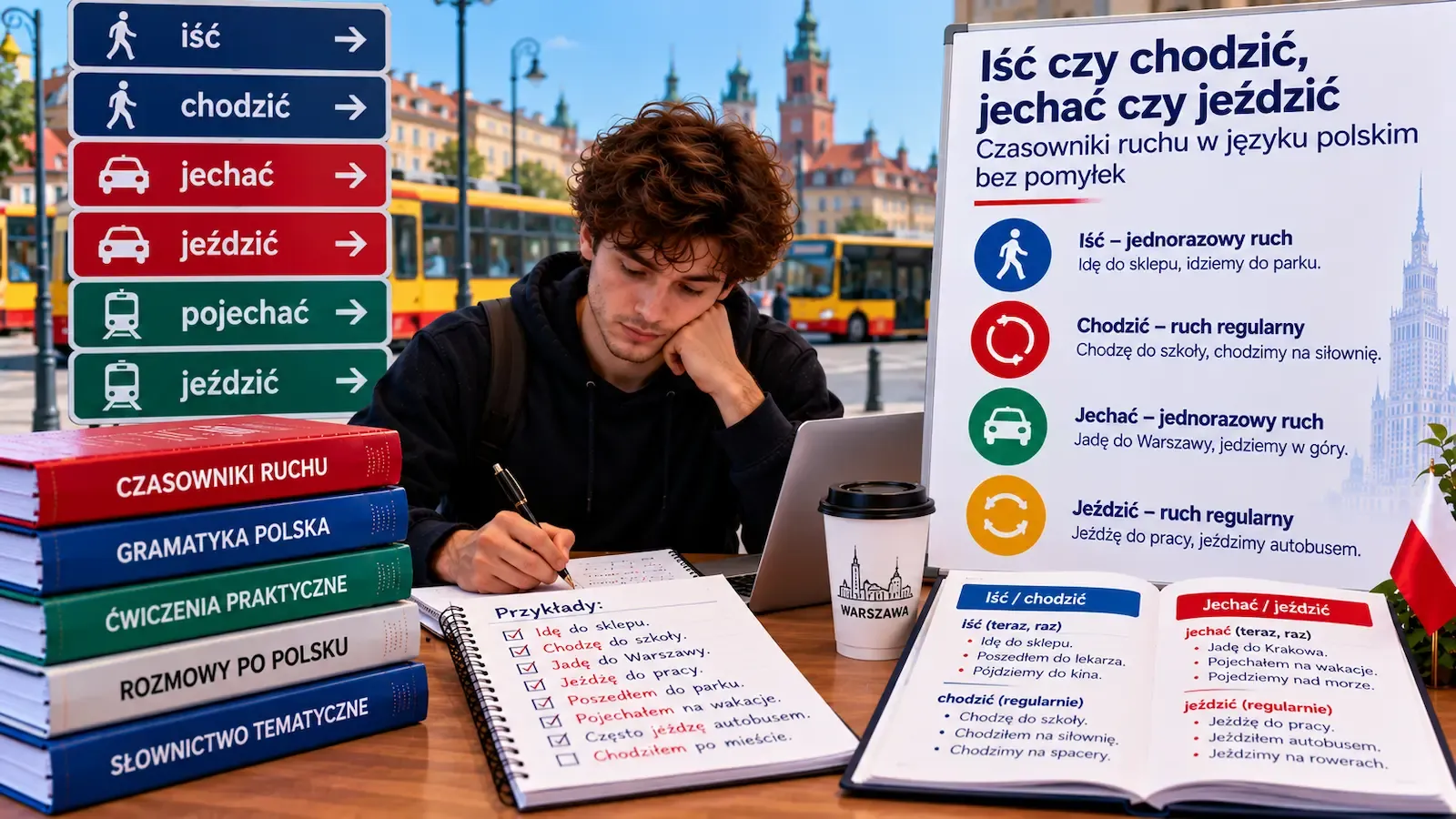

English gets by with "go", "walk", "drive" and "ride", and one verb often serves both a single trip and a habit. Polish does not. It has pairs: iść — chodzić and jechać — jeździć, and within the first weeks in Poland it is clear that this is where the confusion is most common. "Codziennie idę do pracy" does not sound the way the speaker wanted, and "jeżdżę do sklepu" sometimes means something quite different from what they intended. The rule is actually simple, and it helps with more than these two pairs.
We will go through the logic, look at the forms, run through some work examples and then exercise the skill with practice.
One action or a habit: the main difference
In Polish, verbs of motion come in pairs. The first of the pair (the so-called "determinate" one) describes a single movement in one direction that is happening right now. The second ("indeterminate") describes movement that is regular, repeated, in different directions, or as an ability.
- iść — I am walking now, once, to a specific place: Idę do pracy. — I'm walking to work (right now).
- chodzić — I walk regularly, back and forth, or in general: Chodzę do pracy pieszo. — I walk to work (as a habit).
- jechać — I am travelling now: Jadę autobusem. — I'm going by bus.
- jeździć — I travel regularly or know how to drive: Jeżdżę autobusem codziennie. / Umiem jeździć wózkiem widłowym.
So the question "Dokąd idziesz?" (where are you going?) uses the determinate verb, because it asks about one specific movement. And "Gdzie chodzisz do szkoły?" (where do you go to school?) uses the indeterminate one, because it is about a habit.
Present-tense forms
- iść: idę, idziesz, idzie, idziemy, idziecie, idą.
- chodzić: chodzę, chodzisz, chodzi, chodzimy, chodzicie, chodzą.
- jechać: jadę, jedziesz, jedzie, jedziemy, jedziecie, jadą.
- jeździć: jeżdżę, jeździsz, jeździ, jeździmy, jeździcie, jeżdżą.
Note the alternation: in jeździć the first person singular is jeżdżę (with ż), while the other persons have jeździsz, jeździ. It is a common mistake to say "jeździę".
Past tense
In the past tense iść gives szedłem / szłam (a man / a woman), and jechać gives jechałem / jechałam. The indeterminate ones are formed simply: chodziłem / chodziłam, jeździłem / jeździłam. So Wczoraj szedłem do pracy pieszo means one specific movement yesterday, while Kiedyś chodziłem do pracy pieszo means it used to be a habit.
On foot or by transport
Polish clearly separates walking on your own feet from using transport:
- iść / chodzić — only on foot. Idę do sklepu. (on foot).
- jechać / jeździć — by transport: bus, train, car, bicycle. Jadę do Warszawy pociągiem.
A common mistake is to say "autobus chodzi". The correct form is autobus jeździ. And if you want to say that the bus is going now, use jedzie: Autobus jedzie za pięć minut.
Carrying and hauling: verbs with a load
For people who work in a warehouse, one more pair is useful. When you move something by vehicle, we use wieźć / wozić, and when you carry it by hand, nieść / nosić.
- wieźć: wiozę, wieziesz, wiezie, wieziemy, wieziecie, wiozą. Wiozę paletę do hali. — I'm taking a pallet to the hall.
- wozić: wożę, wozisz, wozi, wozimy, wozicie, wożą. Wożę palety wózkiem widłowym. — I move pallets with a forklift.
- nieść: niosę, niesiesz, niesie. Niosę karton do biura. — I'm carrying a box to the office.
- nosić: noszę, nosisz, nosi. Noszę ciężkie paczki cały dzień. — I carry heavy parcels all day.
Habit versus action: a dialogue from work
- — Jak dojeżdżasz do pracy? — How do you get to work?
- — Zwykle jeżdżę autobusem, ale dziś jadę rowerem. — I usually go by bus, but today I'm going by bike.
- — A kiedyś chodziłeś pieszo? — And did you once walk?
- — Tak, ale teraz idę tylko na przystanek. — Yes, but now I only walk to the stop.
Three typical mistakes
- "Codziennie idę do pracy". Correct: codziennie chodzę do pracy. "Every day" calls for the habit verb.
- "Autobus chodzi co dziesięć minut". Correct: autobus jeździ co dziesięć minut.
- "Jeździę do Krakowa". Correct: jeżdżę do Krakowa. In the first person it is always ż.
Practice: fill in the correct form
Choose the right verb from the brackets and put it into the correct form.
- Dziś ___ do pracy autobusem. (jechać / jeździć)
- Codziennie ___ do szkoły pieszo. (iść / chodzić)
- Umiem ___ wózkiem widłowym. (jechać / jeździć)
- Dokąd ___ ? — Do sklepu. (iść / chodzić, you)
- Co dzień ___ palety do hali. (wieźć / wozić, I)
- Autobus ___ co pół godziny. (jechać / jeździć)
- Wczoraj ___ do pracy pieszo. (iść / chodzić, I, a man)
- Zwykle ___ pociągiem, ale dziś jadę autem. (jechać / jeździć, I)
Answers: 1 — jadę; 2 — chodzę; 3 — jeździć; 4 — idziesz; 5 — wożę; 6 — jeździ; 7 — szedłem; 8 — jeżdżę.
Words from job ads: dojazd and dojeżdżać
Job adverts often say "dojazd własny" or "dojazd zapewniony". They come from the same root: dojeżdżać means to travel to your place of work. "Dojazd własny" means you get there yourself at your own cost, "dojazd zapewniony" means the employer arranges transport, and "dojazd busem" means a company minibus. Related verbs are useful too: przyjechać (to arrive) and wyjechać (to leave): Kiedy przyjeżdżasz na zmianę? — When are you coming in for your shift?
How to remember it without tables
A useful hint: if the sentence contains words like "every day", "usually", "sometimes", "never", "every week", take the indeterminate verb (chodzić, jeździć, wozić). If it has "now", "today", "already", "at this moment" and a specific place, take the determinate one (iść, jechać, wieźć). After a few days of practice the choice becomes natural, and the forms jadę — jeżdżę and idę — chodzę stick on their own.
Subscribe to our newsletter:
Latest Posts:
Latest Posts:

Personal pronouns in Polish: go or jego, cię or ciebie, do niego, z nią

Verbs and their cases in Polish: szukam pracy, pomagam koledze, czekam na autobus

Addressing people in Polish: Panie Marku, Pani Anno, Aniu — the vocative

Comparatives and superlatives in Polish: lepszy, tańszy, najlepszy, im więcej — tym więcej