Polish spelling for foreigners: ó or u, rz or ż, ch or h, and the nasal ą, ę
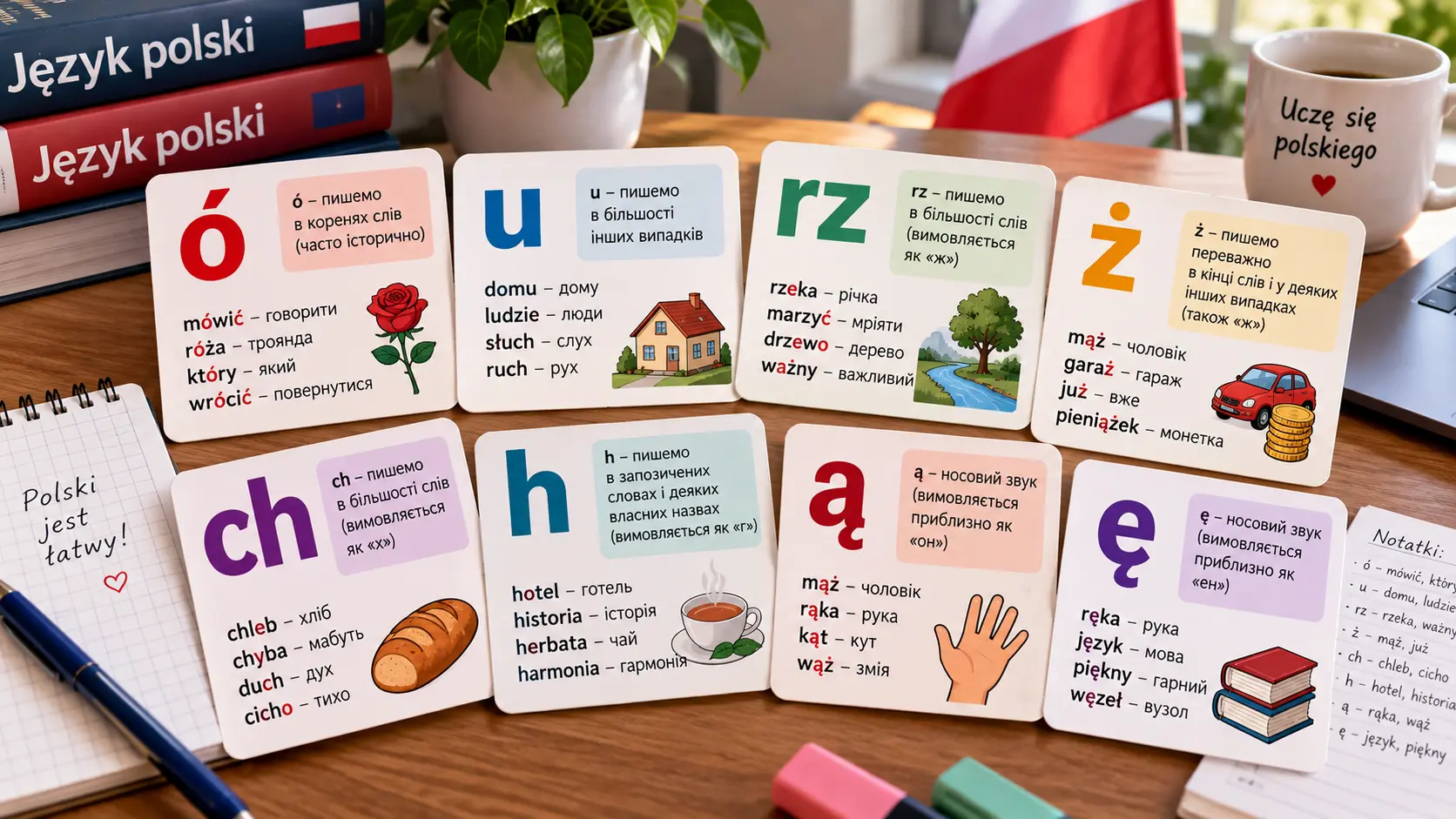

Poles call it "spelling hell" and make mistakes in dictations themselves. One sound, two spellings: "u" and "ó" are pronounced the same, so are "rz" and "ż", and "ch" and "h" are barely different. A foreigner hearing a word simply has no way of knowing how it's written.
A common belief is that Polish spelling can only be learned mechanically, word by word. Partly true, but a few rule-of-thumb patterns cover most cases. They're not a guarantee, but they help you guess right most of the time. The rest you can remember through familiar words.
Ó or U
Both are pronounced like the "oo" in "book". The main clue is alternation.
- Ó if another form of the word has "o". Stół — stoły, mój — moja, Kraków — Krakowa, wózek — wozić.
- Ó in the endings -ów, -ówka. Domów, Polaków, Rzeszów; złotówka, pocztówka.
- U at the start of a word almost always: ul, ucho, uczeń, urząd. (Exceptions are rare, e.g. "ósmy".)
- U in the suffixes -unek, -uch, -usz, -ura. Rachunek, maluch, kapelusz, kultura.
- U in verbs ending in -uję. Pracuję, kupuję, czuję.
RZ or Ż
Pronounced the same (like the "s" in "measure"), but spelled differently.
- RZ if it alternates with "r". Morze — morski, dobrze — dobry, dwór — na dworze.
- RZ in the endings -arz, -erz. Lekarz, kucharz, malarz, rycerz, talerz.
- RZ after b, p, d, t, g, k, ch, j, w. Brzeg, przez, drzwi, trzy, grzyb, krzesło, chrzan, wrzesień. A few words are spelled with "sz" here: pszczoła, pszenica, kształt — memorise them.
- Ż if it alternates with g, z, s, h. Może — mogę, drożej — drogi, wożę — wozić, wyżej — wysoki.
- Ż after l, ł, r, n. Lżej, łże, rżeć, inżynier.
- Ż in words without alternation — to be memorised: żaba, żona, żółty, róża, żart.
CH or H
In modern pronunciation they're almost the same, like the "ch" in Scottish "loch".
- CH is more common. If unsure, write "ch". Chleb, chory, chłopak — and at the end of a word it's almost always "ch": dach, ruch, strach.
- CH alternates with "sz". Mucha — musze, ucho — uszy, cichy — ciszej.
- H alternates with "ż". Druh — drużyna.
- H in loanwords and names. Hotel, historia, herbata, hobby, humor, Hiszpania.
- H in words to memorise. Hałas, hamulec, huśtawka, hak.
The nasal Ą and Ę
These letters have no English equivalent and sound different depending on what follows them:
- Before b, p — like "om", "em": ząb [zomp], dęby [demby].
- Before t, d, c, cz — like "on", "en": kąt [kont], ręce [rentse], często [chensto].
- Before k, g — "on", "en" with the "ng" of "sing": ręka, mąka.
- Before s, z, sz, ż, w, f, ch — a true nasal vowel, like French "on": wąs, gęś, mąż.
- At the end of a word "ę" is almost always pronounced as a plain "e": idę [ide], proszę [proshe]. Word-final "ą" stays nasal: idą, mają.
- Before l, ł the nasality disappears: wziął [vzhow], wzięli [vzheli].
When writing, remember: if you hear "on/om/en/em" inside a word before a consonant, it's often ą or ę. Check the dictionary until you develop a feel for it — that usually comes after a few months of reading.
How to memorise the exceptions
- Word pairs. Learn words together with their check word: stół — stoły, morze — morski.
- Coloured cards. "ó" and "rz" in one colour, "u" and "ż" in another.
- Dictations. Polish online dictations with automatic checking — 10 minutes a week.
- Autocorrect isn't always your friend. It will fix "zeby" to "żeby", but it can't tell "może" (maybe) from "morze" (sea). Both are correct words — with different meanings.
Spelling checklist
- Ó. Look for a form with "o": stół — stoły.
- -ów, -ówka. Always with "ó".
- RZ. Look for a form with "r", or check the consonant before it.
- Ż. Look for alternation with g, z, s: może — mogę.
- CH. When in doubt, "ch"; "h" mostly in loanwords.
- Final ę. It's written even though you barely hear it: idę, proszę.
Subscribe to our newsletter:
Latest Posts:
Latest Posts:
Personal pronouns in Polish: go or jego, cię or ciebie, do niego, z nią
Verbs and their cases in Polish: szukam pracy, pomagam koledze, czekam na autobus
Addressing people in Polish: Panie Marku, Pani Anno, Aniu — the vocative
Comparatives and superlatives in Polish: lepszy, tańszy, najlepszy, im więcej — tym więcej