Dates in Polish: dziesiątego października, w 2026 roku and ordinal numbers

A contract "od pierwszego listopada", pay "do dziesiątego dnia miesiąca", a medical check "dwudziestego trzeciego października". You meet dates in Polish in your first week: in a contract, on a pass, in a schedule, in an application for documents. They are read differently from how they are written, and the same date sounds different depending on whether the question is "what is it today?" or "when?". Let us go through ordinal numbers, months and years so that you can read and say any date.
How to ask about the date
- Którego dzisiaj mamy? — What's the date today?
- Jaka jest dzisiaj data? — What is today's date?
- Kiedy zaczynasz pracę? — When do you start work?
- Do kiedy mam przynieść dokumenty? — By when should I bring the documents?
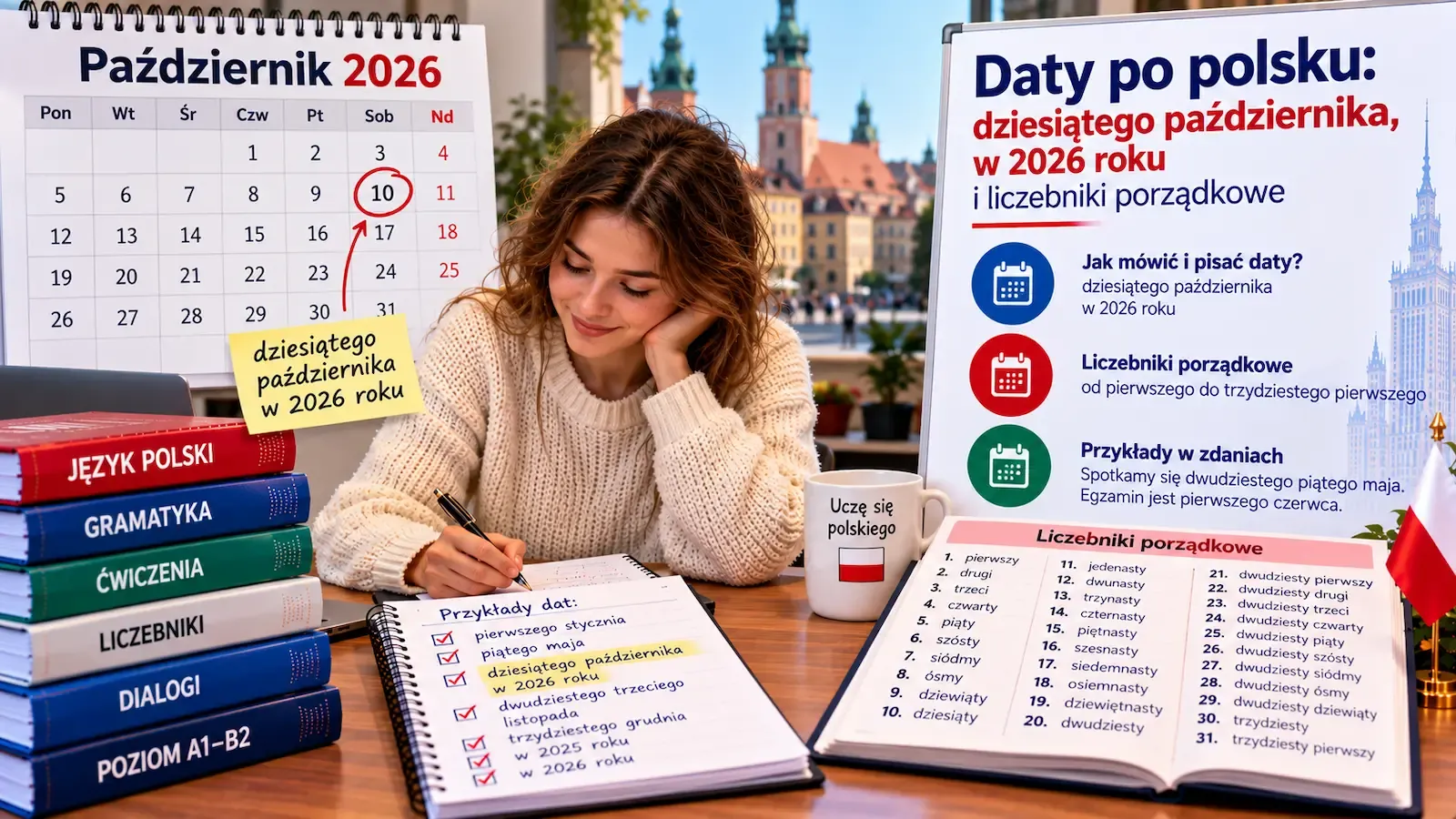
Ordinal numbers 1–31
Dates are built from ordinal numbers, so you need to know them:
- 1 — pierwszy, 2 — drugi, 3 — trzeci, 4 — czwarty, 5 — piąty, 6 — szósty.
- 7 — siódmy, 8 — ósmy, 9 — dziewiąty, 10 — dziesiąty, 11 — jedenasty, 12 — dwunasty.
- 13 — trzynasty, 14 — czternasty, 15 — piętnasty, 16 — szesnasty, 17 — siedemnasty.
- 18 — osiemnasty, 19 — dziewiętnasty, 20 — dwudziesty, 30 — trzydziesty.
In compound numbers only the last part changes: dwudziesty pierwszy (21), dwudziesty trzeci (23), trzydziesty pierwszy (31).
Months: nominative, genitive and locative
Different questions need different forms of the month. Here is the full set:
- styczeń — stycznia — w styczniu
- luty — lutego — w lutym
- marzec — marca — w marcu
- kwiecień — kwietnia — w kwietniu
- maj — maja — w maju
- czerwiec — czerwca — w czerwcu
- lipiec — lipca — w lipcu
- sierpień — sierpnia — w sierpniu
- wrzesień — września — we wrześniu
- październik — października — w październiku
- listopad — listopada — w listopadzie
- grudzień — grudnia — w grudniu
We use the genitive in dates (dziesiątego października) and the locative when we speak about the month in general (w październiku — in October). Before "wrzesień" an e is added again: we wrześniu.
What's the date and when is the event
This is where the forms are usually mixed up. For the question "what's the date?" the ordinal stands in the nominative and the month in the genitive: Dziś jest dziesiąty października. But for "when?" both words stand in the genitive: Zaczynam pracę dziesiątego października.
- Dziś jest piętnasty maja. — Today is the fifteenth of May.
- Urodziłem się piętnastego maja. — I was born on the fifteenth of May.
- Dziś jest pierwszy września. — Today is the first of September.
- Pierwszego września zaczyna się szkoła. — School starts on the first of September.
Years: how to read 2026
A year is read in full, with an ordinal in the last part: dwa tysiące dwudziesty szósty (2026). In a sentence with the preposition w it is used in the locative: w dwa tysiące dwudziestym szóstym roku. For earlier years it is the same: 1998 is tysiąc dziewięćset dziewięćdziesiąty ósmy, and w 1998 roku sounds like w tysiąc dziewięćset dziewięćdziesiątym ósmym roku.
When you read a full date, the genitive logic stays the same: 10 października 2026 roku is dziesiątego października dwa tysiące dwudziestego szóstego roku. In practice Poles often shorten, but in documents and at an interview it is better to say the full form.
Deadlines at work: od, do, na początku, na końcu
- Umowa jest od pierwszego listopada. — The contract runs from the first of November.
- Wypłata do dziesiątego dnia miesiąca. — Pay by the tenth day of the month.
- Mam badania dwudziestego trzeciego października. — I have my medical on the twenty-third of October.
- Urlop w sierpniu. — Holiday in August.
- Na początku miesiąca, w połowie miesiąca, na końcu miesiąca. — At the start, in the middle, at the end of the month.
Useful words: do + genitive (until), od + genitive (from), w połowie (in the middle), przed + instrumental (before), po + locative (after): po pierwszym, przed piątym.
Date of birth on documents
On forms you will see the phrase data urodzenia. The date is written in digits (12.03.1998) and read in full: dwunastego marca tysiąc dziewięćset dziewięćdziesiątego ósmego roku. Place of birth is miejsce urodzenia, age is wiek.
A dialogue about deadlines
- — Kiedy mogę zacząć pracę? — When can I start work?
- — Od pierwszego listopada. Umowa jest do trzydziestego kwietnia. — From the first of November. The contract runs to the thirtieth of April.
- — A kiedy jest wypłata? — And when is payday?
- — Do dziesiątego dnia każdego miesiąca. — By the tenth day of each month.
Three typical mistakes
- "Zaczynam pracę dziesiąty października". Correct: dziesiątego października. For "when?" the ordinal is in the genitive.
- "W październik". Correct: w październiku. A month with w takes the locative.
- "W dwa tysiące dwadzieścia sześć roku". Correct: w dwa tysiące dwudziestym szóstym roku. A year takes an ordinal number.
Practice
Put the words in brackets into the right form.
- Dziś jest ___ października. (piąty)
- Zaczynam pracę ___ listopada. (pierwszy)
- Mam urlop ___ sierpniu. (w)
- Urodziłem się ___ marca 1998 roku. (dwunasty)
- Umowa jest ___ trzydziestego kwietnia. (do/od)
- Pracuję tu ___ 2024 roku. (z/od)
- Wypłata jest ___ dziesiątego dnia miesiąca. (do/od)
- Lato zaczyna się ___ czerwcu. (w)
Answers: 1 — piąty; 2 — pierwszego; 3 — w; 4 — dwunastego; 5 — do; 6 — od; 7 — do; 8 — w.
Summary
Remember the scheme: "what's the date?" — dziesiąty października, "when?" — dziesiątego października, "in which month?" — w październiku. In compound ordinals only the last word changes, and a year is read in full. In a few days you will read a contract without stumbling.
Subscribe to our newsletter:
Latest Posts:
Latest Posts:

Personal pronouns in Polish: go or jego, cię or ciebie, do niego, z nią

Verbs and their cases in Polish: szukam pracy, pomagam koledze, czekam na autobus

Addressing people in Polish: Panie Marku, Pani Anno, Aniu — the vocative
Comparatives and superlatives in Polish: lepszy, tańszy, najlepszy, im więcej — tym więcej