How to read Polish books so you actually learn the language
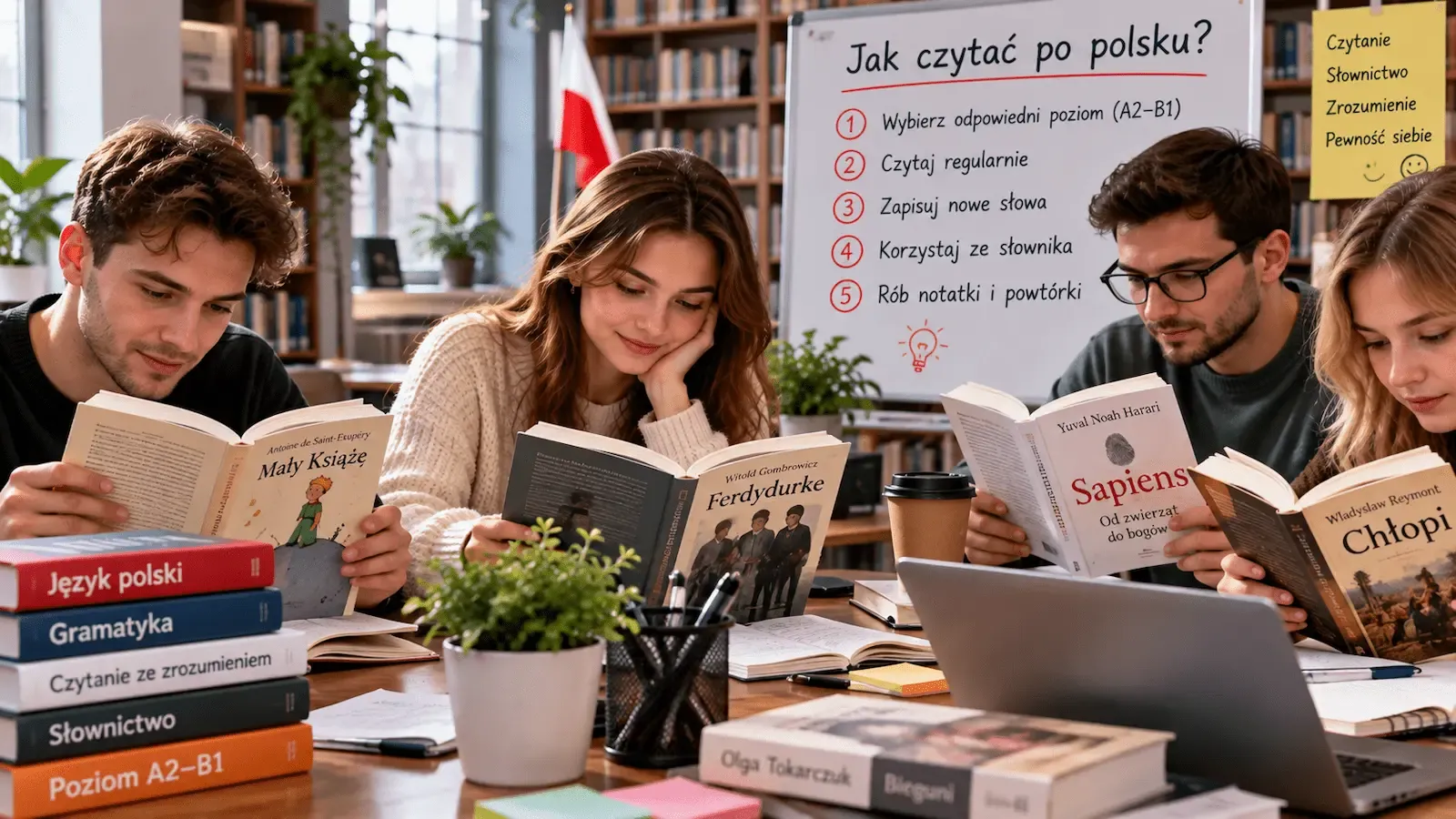

Andriy read three books in Polish in six months — and barely noticed any difference in his language. He read with a dictionary, translated every unknown word, and the next day remembered none of them. His colleague Olha read just one book in the same time, but afterwards started using expressions in conversation she hadn't known before.
A common belief: the more you read, the better your language. Partly true, but quantity doesn't replace method. Reading can be entertainment that gives little, or one of the most effective ways to learn a language. The difference lies in a few simple habits.
Two kinds of reading — and you need both
- Extensive (a lot, easily). You read a text where you understand almost everything, don't stop at every word and follow the plot. This trains speed, familiarity with grammar and a "feel" for the language.
- Intensive (a little, carefully). You take one page apart in detail: noting expressions, analysing grammar, rereading aloud. This builds your active vocabulary.
The best ratio at A2–B1: 80% easy reading, 20% careful study.
The 95% rule
If you understand about 95% of the words, new ones stick from context almost effortlessly. At 80% you're no longer reading but decoding, and you tire quickly. So a book to "grow into" is a bad idea. Better to read three easy books than get stuck halfway through a hard one.
When to look a word up and when not to
- Don't look it up if the word is clear from context or appears once and doesn't get in the way of the plot.
- Look it up if it repeats on every page or you can't follow what's happening without it.
- Mark unknown words in pencil but look them up after the chapter, not straight away. Half will become clear from the rest of the text.
A phrase notebook instead of a word list
Don't write "zapominać — to forget"; write the whole phrase from the book: "zapomniał kluczy" — he forgot the keys. You can see at once that zapomnieć takes the genitive case — something no English construction will warn you about. That way you remember not just the word but the case it goes with and the natural word order. After a month the notebook becomes your personal phrasebook.
Read aloud — at least a page
Reading aloud trains pronunciation and forces your brain to process every word instead of skimming. It's especially useful for sounds that are hard in Polish: sz, cz, ś, ć, rz and the nasal ą, ę. One page a day is enough — ideally with a pencil to mark where you stumbled.
An audiobook alongside the text
Listening and reading the same text at the same time is one of the best ways to learn to understand spoken Polish. You see how a word is written and hear how it sounds in fast speech. Try listening to a chapter with the book in hand, and the next day to the same chapter without the text.
Retelling: a comprehension test
After each chapter, retell it in Polish — aloud or in writing, 3–5 sentences. Mistakes don't matter: this is the step from passive to active knowledge. Words you used in a retelling stick much better than ones you only read. Record your retellings on your phone — after a month, listen to the first and the latest and compare.
How much to read
- A little every day. 15–20 minutes daily beats two hours once a week.
- A ritual. Tie reading to a habit: on the way to work, before bed.
- A page target. For example, 10 pages a day — and in a month you've finished a book.
What to avoid
- Translating every word — reading turns into dictionary work.
- Books that are too hard — fatigue and disappointment.
- Only one genre. If you only read crime novels, your vocabulary gets one-sided — alternate with everyday fiction or news.
- Reading "for later" without review — without a notebook and retelling, most new words are forgotten.
Weekly reading checklist
- Easy reading. 15–20 minutes a day without a dictionary.
- Careful study. One page a week in detail.
- Notebook. 10–15 phrases from the book per week.
- Aloud. One page a day out loud.
- Audio. One chapter with the audiobook alongside.
- Retelling. A short retelling of each chapter in Polish.
Subscribe to our newsletter:
Latest Posts:
Latest Posts:
Personal pronouns in Polish: go or jego, cię or ciebie, do niego, z nią
Verbs and their cases in Polish: szukam pracy, pomagam koledze, czekam na autobus
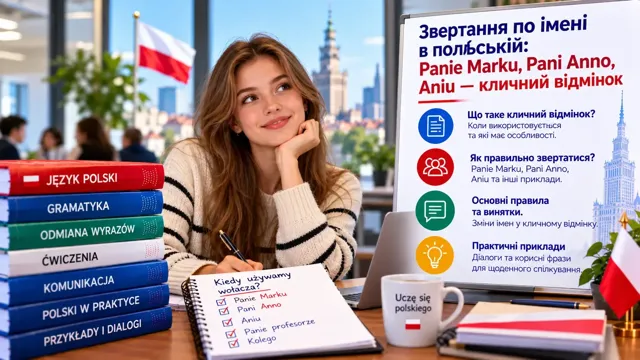
Addressing people in Polish: Panie Marku, Pani Anno, Aniu — the vocative
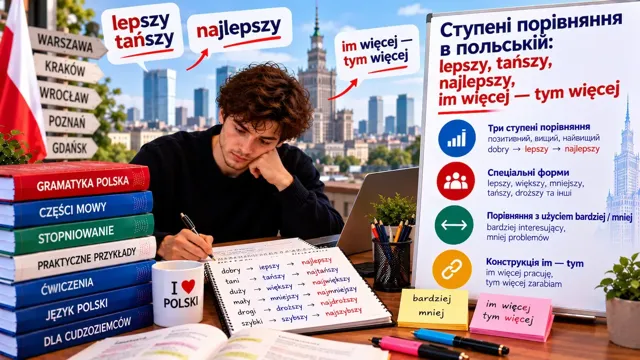
Comparatives and superlatives in Polish: lepszy, tańszy, najlepszy, im więcej — tym więcej