Karta Polaka for a child: when no interview is needed and which documents to collect
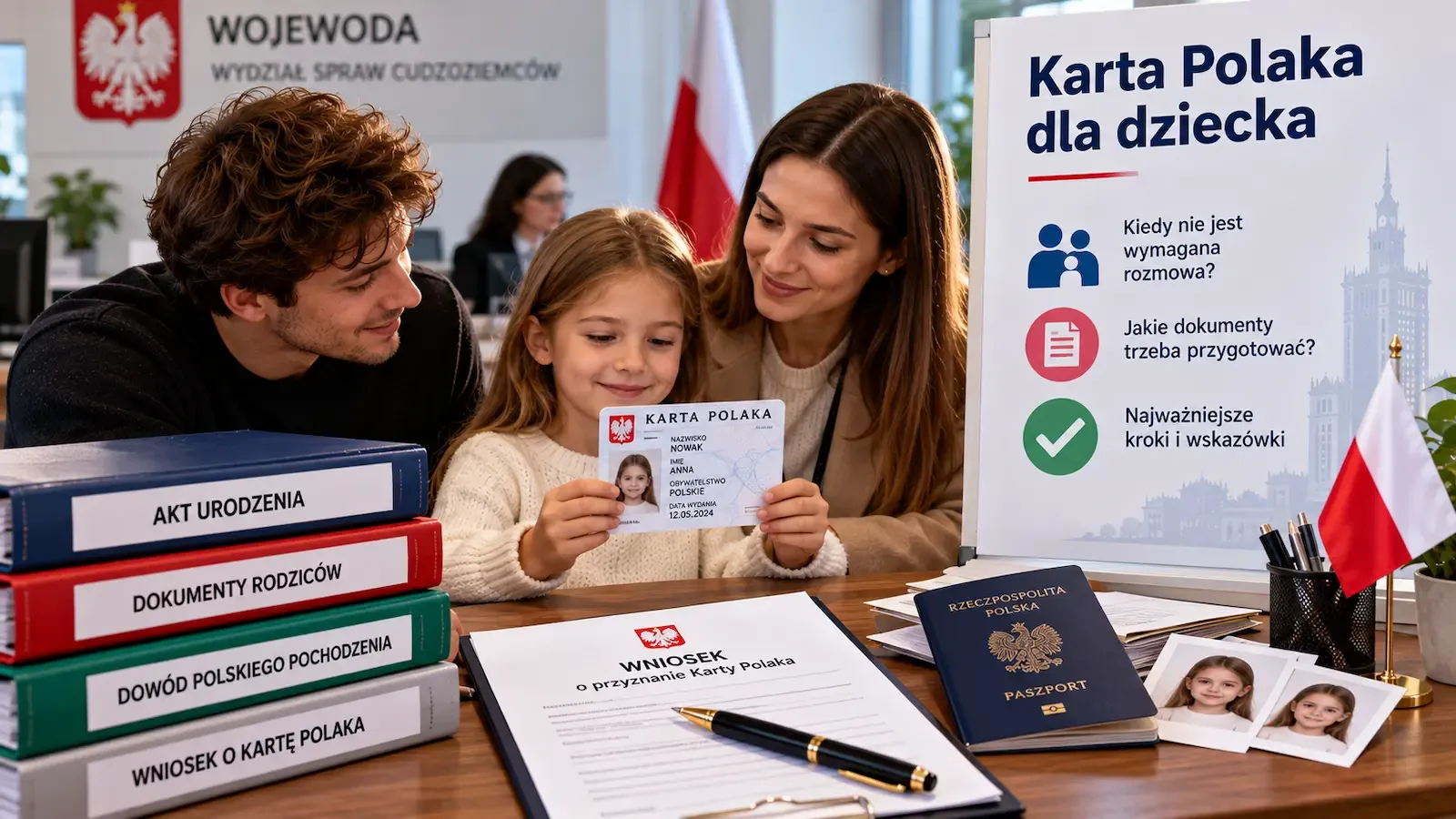

Ihor received his Karta Polaka three years ago — after a long hunt for archive records about his grandfather and an interview at the consulate. When the family moved to Wrocław, the question of their son came up. Ihor was sure twelve-year-old Maksym would have to go through the same route: proving his roots, learning history, sitting a conversation with the consul.
A common assumption is that a child's Karta Polaka is arranged the same way as an adult's. In fact the law provides a simpler route for minors: if at least one parent already holds Karta Polaka, the child can get it on that basis — without separately proving Polish origin.
Two routes for minors
- Through a parent. One parent holds Karta Polaka — the child gets the card on the parents' application. This is the most common and simplest option.
- Independently. If neither parent has the card but the child meets the general conditions (Polish origin, ties to Polishness), an application can still be made. Then documents proving origin are needed, just as for an adult.
Who applies
For a minor, the parents or legal guardians apply. The key detail is both parents' consent. If one parent applies, the other's written consent is needed. When the other parent lives in another country or is out of touch, this becomes the hardest part of the whole case, so deal with it early.
If one parent has lost parental rights or has died, this is confirmed with a document — a court ruling or death certificate. Older children usually sign the application together with their parents — check the requirements for your child's age with the office where you apply.
Documents to prepare
- Application on the official form, filled in in Polish.
- Photo of the child — as for Polish documents.
- Birth certificate naming the parents, with a Polish translation.
- A parent's Karta Polaka — original to show and a copy.
- Passports of the parents and of the child, if they have one.
- The other parent's consent — notarised or signed in person at the office.
The list may differ between consulates and voivodeships. Before your visit, check the current requirements on the website of the office you're applying to.
Where to apply
If the family lives abroad — to a Polish consul. If you're already in Poland legally — to the voivode where you live. Karta Polaka is issued free of charge; there's no fee for the card itself, though you'll pay for translations and notarised documents.
How long it takes
Processing time depends on the office and its workload: at consulates the queue to apply can be longer than the processing itself, while at voivodes it's the other way round. Count on several months. If your child needs the card by a certain date — e.g. university admission or a move — apply at least six months ahead and keep proof of submission.
What Karta Polaka gives a child in Poland
- Education. Free study in Polish schools and universities on the same terms as Poles, plus the chance to receive scholarships.
- Healthcare. The right to emergency medical care in certain cases — full NFZ access depends on the family's insurance.
- Residence. If the family moves to Poland permanently, Karta Polaka holders can get a karta stałego pobytu on favourable terms.
- Future citizenship. After a year of permanent residence based on Karta Polaka you can apply to be recognised as a citizen — for a child this usually happens together with the parents.
Karta Polaka and changing schools
For a child who moves in the middle of the school year, Karta Polaka isn't required for school enrolment: foreign children have the right to attend Polish schools without it. But it makes university admission easier a few years later — then the card gives the right to free study in Polish. So it's better to arrange it in advance, not in the year of admission.
Checklist: Karta Polaka for a child
- Basis. Check whether either parent holds Karta Polaka.
- Consent. Agree written consent with the other parent.
- Certificate. Get a sworn translation of the birth certificate.
- Office. A consul if you live abroad, the voivode if you're already in Poland.
- Requirements. Check the current document list on the office's website.
- Plans. Think about a route to karta stałego pobytu for the whole family.
Subscribe to our newsletter:
Latest Posts:
Latest Posts:
Personal pronouns in Polish: go or jego, cię or ciebie, do niego, z nią
Verbs and their cases in Polish: szukam pracy, pomagam koledze, czekam na autobus
Addressing people in Polish: Panie Marku, Pani Anno, Aniu — the vocative
Comparatives and superlatives in Polish: lepszy, tańszy, najlepszy, im więcej — tym więcej