Okres próbny, określony, nieokreślony: three types of employment contract in Poland
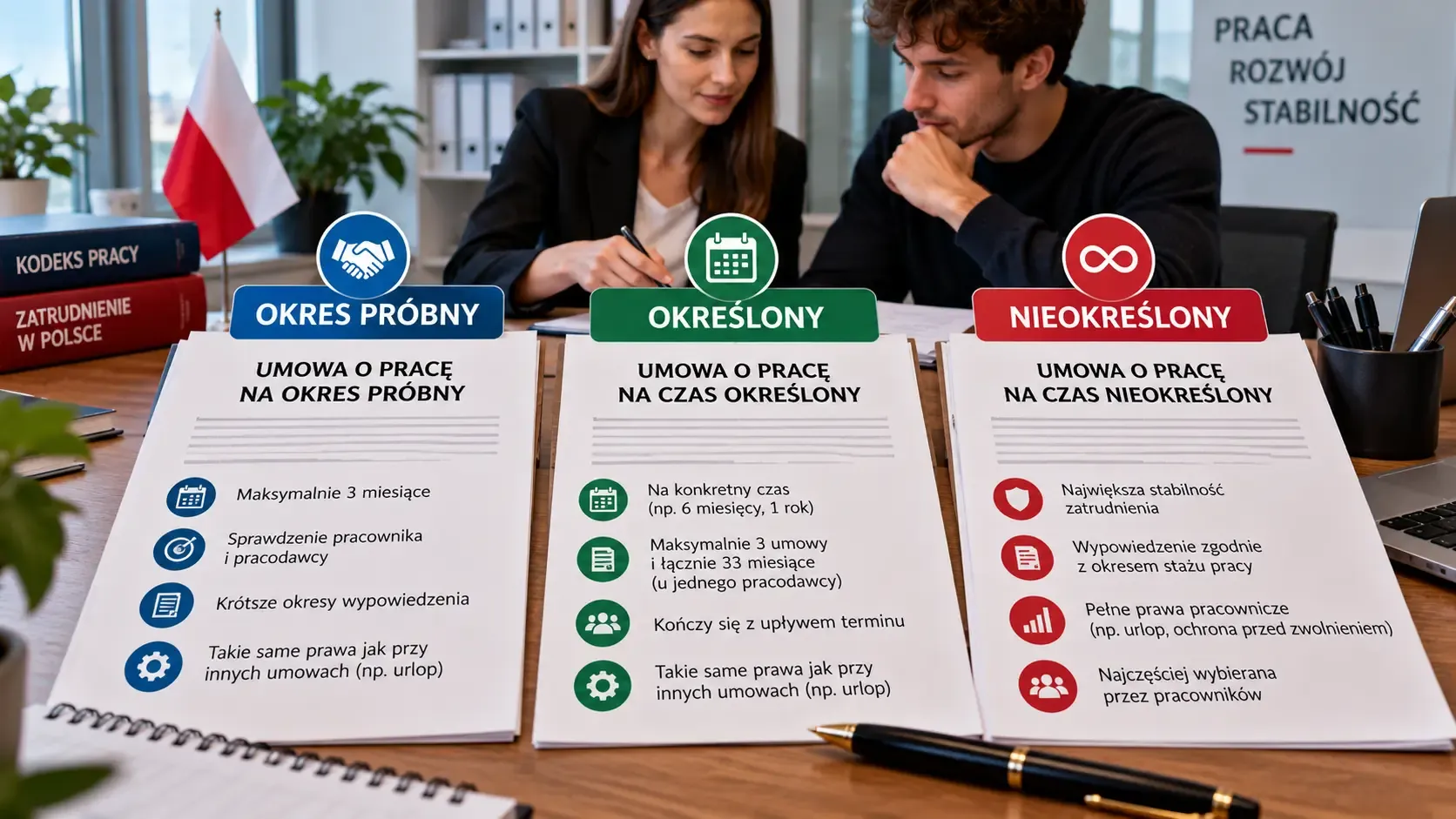

To many people "umowa o pracę" sounds like a guarantee: sign it and you're "on staff". But in Poland an employment contract comes in three types, and which one you have determines how easily you can be dismissed and how much notice you must give when you leave.
A common belief is that a czas określony contract is "worse" and can be ended at any time. That's no longer true: since 2016 its notice periods have been the same as for an open-ended contract, and since 2023 the employer also has to give a reason. The difference between the types is smaller today than many think — but it's there.
1. Umowa na okres próbny — trial contract
A "test" for both sides. Its maximum length depends on the length of the next planned contract:
- Up to 1 month — if the next contract is planned for less than 6 months.
- Up to 2 months — if the next contract is for 6–12 months.
- Up to 3 months — in other cases, including before an open-ended contract.
Notice on a trial contract is short: 3 working days if it's up to two weeks; 1 week if longer than two weeks; 2 weeks for a 3-month trial. A second trial contract with the same employee is only allowed in exceptional cases — e.g. for a completely different job.
2. Umowa na czas określony — fixed-term contract
The most common type for foreigners, especially via agencies. It ends on a specific date, but the law limits how many times it can be renewed:
- No more than 33 months in total with one employer.
- No more than 3 contracts in a row.
- A fourth contract or month 34 — and the contract is automatically treated as open-ended.
There are exceptions: contracts to replace an absent employee, seasonal work, work for a term of office. These don't count towards the limit.
3. Umowa na czas nieokreślony — open-ended contract
The most stable option. It has no end date, and to dismiss you the employer must give a specific, real reason. Banks are more willing to lend, landlords to rent, and for a residence or resident card such a contract is good proof of stable income.
Notice periods: the same for określony and nieokreślony
For both contracts the period depends on how long you've worked for this employer:
- Under 6 months — 2 weeks.
- 6 months to 3 years — 1 month.
- Over 3 years — 3 months.
The periods work both ways: if you resign, you also have to work out your notice. But you can always agree on termination by mutual agreement on any date.
What every employment contract must include
- Written form before you start. The contract is signed before your first working day, not "next week when accounts have it ready".
- Information on working conditions. Within 7 days the employer must tell you in writing about working hours, breaks, holiday, notice periods and more.
- ZUS registration. Within 7 days of starting work. You can check it in PUE/eZUS.
- Position, place, pay, working time. Without them the contract is incomplete.
Using this in practice
If you've been on czas określony contracts with one company for two years, count the months and the contracts. Approaching 33 months or a fourth contract, the employer will either offer an open-ended contract or not continue. Knowing this in advance, you can negotiate or calmly look for a new job.
One more thing: if an employer ends your czas określony contract, you have the right to know the reason — just as with an open-ended one. If no reason is given or it's made up, the dismissal can be appealed to a labour court within 21 days.
Checklist: what contract do I have
- Title. Look for "na okres próbny", "na czas określony" or "na czas nieokreślony".
- End date. Find it and put it in your calendar.
- Limit. Count how many contracts and months you've had with this employer.
- Notice. Work out your period from your length of service there.
- Information. Check you received your working conditions in writing within 7 days.
- ZUS. Confirm in PUE/eZUS that you've been registered.
Subscribe to our newsletter:
Latest Posts:
Latest Posts:

Personal pronouns in Polish: go or jego, cię or ciebie, do niego, z nią
Verbs and their cases in Polish: szukam pracy, pomagam koledze, czekam na autobus

Addressing people in Polish: Panie Marku, Pani Anno, Aniu — the vocative
Comparatives and superlatives in Polish: lepszy, tańszy, najlepszy, im więcej — tym więcej