Ryczałt in Poland: which rate for which activity and when it pays off
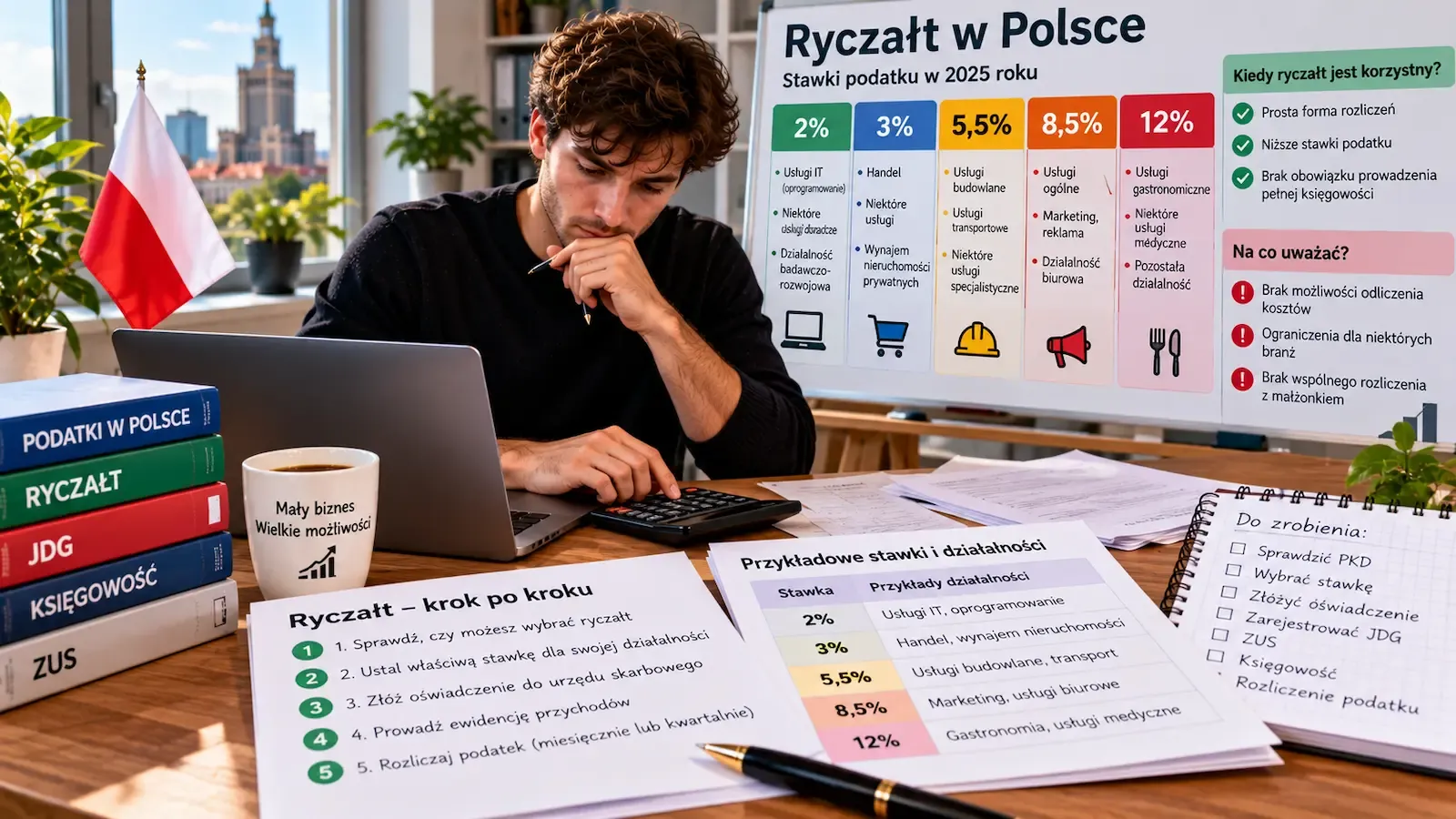

Ryczałt is often described in one sentence: "you pay 12% on everything and live in peace." In reality 12% is just one of several rates, and for many professions it's either higher or lower. More importantly, ryczałt is charged on revenue without deducting costs, so for some it's the best option and for others the most expensive.
Below: how to pick a rate, who ryczałt doesn't suit, and how to tell whether it pays off for you. Rates in Poland depend on the type of activity, and the final one is always worth confirming with an accountant or through an official tax ruling.
How ryczałt works
Tax is charged on przychód — everything you invoiced clients, without deducting costs. You can't reduce the tax by office rent, a laptop or fuel. On the other hand, bookkeeping is simpler: a revenue register is enough, with no cost ledger.
Part of the health contribution (składka zdrowotna) can be deducted from revenue, and ZUS social contributions also reduce the base. But the key rule stands: the higher your costs, the less ryczałt suits you.
The rates
- 3% — trade, catering (without alcohol above 1.5%).
- 5.5% — manufacturing and construction work.
- 8.5% — most services not listed separately: e.g. repairs, cleaning, many kinds of service work.
- 12% — most IT services, including programming.
- 14% — healthcare, services of architects and engineers, some consulting and technical services.
- 15% and 17% — specific services named directly in the law; less common.
The rate depends not on your job title but on the classification of the specific service (PKWiU). The same "IT person" can pay 12% for programming and 8.5% for other services. If in doubt, you can apply for an individual tax ruling (interpretacja indywidualna).
Who can't choose ryczałt
- Former employer. If you provide services to a company where you were employed this year or last year, in the same scope, that income can't be on ryczałt.
- High revenue. The limit is 2 million euro of revenue in the previous year.
- Certain activities. E.g. some financial services and trade in certain goods — the law lists the exclusions.
Health contribution on ryczałt
On ryczałt the składka zdrowotna is fixed but depends on annual revenue. There are three thresholds: up to 60,000 zł, from 60,000 to 300,000 zł, and over 300,000 zł a year. The higher the threshold, the bigger the contribution. The amounts change every year because they're linked to the average wage — ZUS or your accountant will give you current figures.
How to choose and change the tax form
You can choose ryczałt when registering in CEIDG or by notifying the tax office by the 20th of the month after the one in which you earned your first revenue of the year. Miss that deadline and you stay on your current form until the end of the year. The tax form can be changed once a year.
Example: two tradesmen with the same revenue
Two finishing contractors each invoice 12,000 zł a month. The first works with the client's materials and has almost no costs: on 5.5% ryczałt the tax is about 660 zł. The second buys materials himself for 9,000 zł. On the flat tax his base is only 3,000 zł, and 19% of that is 570 zł — less than on ryczałt. Same revenue, different costs — and a different right choice.
When ryczałt pays off and when it doesn't
- Pays off: few costs, services with a low rate (8.5% or 12%), stable income.
- Doesn't pay off: high costs — rent, equipment, a car, subcontractors. Then the flat tax or the scale with cost deductions is often cheaper.
- Neutral: small income, where the difference between forms is a few dozen złoty a month. Then simple bookkeeping matters most.
A rough guide, ignoring contributions: at 12%, ryczałt usually loses to the flat tax when costs exceed about a third of revenue; at 8.5% — about half; at 5.5% — around 70%. The health contribution is calculated differently on each form, so make the final comparison with an accountant.
Checklist before choosing ryczałt
- Service code. Identify the PKWiU of your services and the matching rate.
- Client. Make sure it's not your former employer in the same scope.
- Costs. Work out what share of revenue they make up.
- Threshold. Estimate annual revenue for the health contribution.
- Deadline. Notify the tax office by the 20th after your first revenue.
- Advice. Check the calculation with an accountant before your first invoice.
Subscribe to our newsletter:
Latest Posts:
Latest Posts:

Personal pronouns in Polish: go or jego, cię or ciebie, do niego, z nią

Verbs and their cases in Polish: szukam pracy, pomagam koledze, czekam na autobus

Addressing people in Polish: Panie Marku, Pani Anno, Aniu — the vocative

Comparatives and superlatives in Polish: lepszy, tańszy, najlepszy, im więcej — tym więcej