
Poland Work Visa and Work Permit in 2026: A Step-by-Step Guide for Non-EU Workers


Found our content useful? Add Jobework to your preferred sources and Google will show you our articles more often.
Almost everyone from outside the EU who plans to work in Poland asks the same thing first: "Which visa do I need?" The honest answer is that the visa is the second step, not the first. In Poland, the right to work and the right to stay are two separate things. Usually the employer starts the process by getting permission for you to work, and only then do you apply for a visa at a Polish consulate. If someone offers to sell you "a work visa" with no real employer and no permit behind it, that alone is a warning sign.
This guide walks through how the system usually works in 2026: who needs a permit, which documents people are asked for, how long each stage tends to take and what changes once you are in Poland. The rules change often (a new law on employing foreigners came into force in 2025), so treat the numbers below as typical ranges. Before you pay for anything, confirm the details on official government websites or with the consulate.
Who needs a work permit and who doesn't
Citizens of the EU, the EEA (Norway, Iceland, Liechtenstein) and Switzerland can work in Poland without a permit and without a visa. If they live here for longer than three months, they simply register their stay.
Everyone else generally needs two things:
- Permission to work — most often a work permit (zezwolenie na pracę) issued for a specific employer and a specific job;
- A legal basis to stay — usually a national D visa (wiza krajowa typu D) issued for the purpose of work, and later a residence card if you stay longer.
There are exceptions. Graduates of Polish universities, holders of a permanent residence permit or EU long-term resident status, and some other groups can work without a separate permit. Full-time students at Polish universities are also exempt for most jobs. If you are not sure whether you belong to one of these groups, check the list on the official Polish government portal on employing foreigners before you start.
Citizens of Ukraine are in a special situation in Poland: they currently work under separate rules (a simple notification by the employer instead of a permit, plus special residence arrangements). This guide is mainly for citizens of other non-EU countries.
The main types of permission
- Work permit type A (zezwolenie na pracę typu A) — the standard route: a Polish employer hires you on a contract in Poland. Most warehouse, factory, construction and driving jobs go this way.
- Seasonal work permit (zezwolenie na pracę sezonową) — for agriculture, gardening, fruit picking and some tourism and hospitality jobs; it covers up to 9 months in a calendar year.
- Declaration of entrusting work (oświadczenie o powierzeniu wykonywania pracy cudzoziemcowi) — a simplified and faster procedure open only to citizens of a short list of countries (in recent years: Armenia, Belarus, Georgia, Moldova and Ukraine). The list has changed before, so check the current version.
- Other types (B, C, D, E) — for company board members, people posted to Poland by a foreign employer and similar cases. Most job seekers never deal with them.
A permit is tied to the employer, the position and the conditions written in the decision. Keep that in mind; it matters a lot later, when people want to change jobs.
Step by step: from job offer to your first day at work
1. Find a real employer and get the offer in writing
Everything starts with an employer who is ready to hire you and to handle the paperwork. You can start by browsing jobs in Poland for foreigners and then ask whether a particular employer actually recruits from abroad — not every company is willing to wait several months for a visa. Ask for the details in writing: job title, city, gross pay per hour or per month, type of contract, working hours and whether housing is included. Many entry-level jobs come with housing arranged by the employer, usually 350–550 PLN a month — see jobs with accommodation. Pay cannot be lower than the national minimum: in 2026 that is 4,806 PLN gross a month or 31.40 PLN gross an hour. On a standard employment contract (umowa o pracę), 4,806 PLN gross works out at roughly 3,606 PLN take-home.
2. The employer applies for the work permit
A type A permit is issued by the voivode's office (urząd wojewódzki) in the region where the company is registered. Seasonal permits and declarations are handled by the district labour office (powiatowy urząd pracy). Under the current rules, applications are filed electronically through the government portal praca.gov.pl. The employer will need from you a copy of every passport page with your data, your full name in Latin letters exactly as in the passport, your date of birth and sometimes proof of qualifications or experience — a driving licence, a welding certificate and so on.
The fee for the permit is paid by the employer, not by you. The amount depends on the type and length of the permit and is in the range of a few hundred zloty (check the current rates). The employer must also offer pay that is at least the minimum wage and not lower than what Polish workers get in the same position. Waiting time ranges from a few weeks to several months; queues are longer in the big regions. When the permit is issued (or the declaration is registered), the employer sends you a copy, because you need it for the visa.
3. Book a consulate appointment and apply for a D visa
You apply at a Polish consulate or at the official visa application centre that the consulate uses in your country. In parts of South Asia and Africa the hardest part is simply getting an appointment: people sometimes wait weeks or months for a slot. You fill in the online application form, come with your documents (list below) and give your fingerprints. The consular fee for a national visa is usually around 80 EUR, plus a service fee if you apply through a visa centre (check exact amounts with the consulate). Officially the decision is made within 15 days, but in practice it often takes longer. You may be invited to a short interview: where you will work, what you will do, how much you will earn, where you will live. Answer exactly as it is written in your permit and offer. A D visa for work is normally issued for the length of the permit, but for no more than one year.
4. Arrive, sign the contract and start legally
The contract is signed before your first working day. You should get it in writing and, if you don't speak Polish, with a translation into a language you understand. Before you start, two things are compulsory: health and safety training (BHP) and a medical check with an occupational doctor (badania lekarskie medycyny pracy), which the employer pays for. The employer also has to tell the authorities that you have started work within the deadline set by law (for declarations it is 7 days — check for your case). The first salary usually arrives around the 10th of the following month, so plan your money for at least four to six weeks.
5. Register your address and get a PESEL number
If you stay in Poland for longer than 30 days, you register your temporary address at the city or municipal office (zameldowanie na pobyt czasowy), as a rule no later than the 30th day after arrival. You need your passport and a rental agreement or a confirmation from the owner of the flat; if you live in employer housing, ask the employer for that document. PESEL, the Polish national identification number, is needed for a bank account, the doctor, taxes and a phone contract. It is often assigned when you register your address, or you can request it separately.
6. Apply for a residence card if you are staying longer
If you plan to work longer than your visa allows, you apply for a single permit for temporary residence and work (jednolite zezwolenie na pobyt czasowy i pracę). After a positive decision you receive a residence card (karta pobytu), usually valid for up to 3 years. The key rule: apply while you are still in Poland legally, which means before your visa expires. Applications are now submitted online through the MOS system, after which you visit the voivode's office in person to give fingerprints. Fees are roughly 440 PLN for the permit and 100 PLN for the card itself (check). While your case is pending, your stay is legal, but travelling outside Poland may be restricted. In big cities a decision often takes 6 to 12 months, sometimes more.
Typical timeline
| Stage | Who does it | Typical time (check) |
|---|---|---|
| Job offer and documents for the employer | you and the employer | 1–3 weeks |
| Work permit type A | employer, voivode's office | 1–3 months, sometimes longer |
| Seasonal permit or declaration | employer, labour office | 1–4 weeks |
| Consulate appointment | you | a few days to several months, depending on the country |
| Visa decision | consulate | 2–4 weeks, sometimes longer |
| Travel and start of work | you and the employer | 1–2 weeks |
| Address registration and PESEL | you | within 30 days of arrival |
| Residence card decision | voivode's office | 6–12 months or more |
Realistically, three to six months pass between the job offer and your first day at work. In countries with long visa queues, expect more.
Documents people are usually asked for
For the employer's permit application
- a copy of all filled-in passport pages;
- your personal details: full name in Latin letters, date and place of birth, citizenship;
- proof of qualifications if the job requires them (licences, diplomas, certificates);
- for some professions, proof of work experience.
For the D visa
- a completed and signed visa application form;
- a passport valid for at least 3 months after the visa ends, with two blank pages;
- a biometric photo, 35×45 mm;
- a copy of the work permit or the registered declaration;
- travel medical insurance (usually with cover of at least 30,000 EUR);
- proof of accommodation (a letter from the employer or a rental agreement);
- proof of funds or of your working conditions — some consulates ask for this as well;
- a receipt for the visa fee.
For the residence card
- the application submitted through MOS and a photo;
- your passport;
- your employment contract;
- annex no. 1 filled in by the employer (załącznik nr 1);
- proof of health insurance (registration with ZUS by the employer);
- proof of address;
- receipts for the fees.
Changing employer
A work permit is issued for one specific company. If you move to another employer, the new one normally has to get a new permit for you before you start working there. You cannot work "while the papers are being done": working for a company other than the one named in your permit counts as illegal work. The consequences can include a return decision, a ban on entering the Schengen area for several years and a fine for the employer.
With a residence card tied to an employer, changing jobs usually means changing the permit or getting a new decision; the newer rules make some changes simpler, but it depends on the case. If you lose your job, don't stay silent: inform the voivode's office within the required deadline and ask how much time you have to find a new employer (check the current rules).
Scams and common mistakes
- "Guaranteed visa". Nobody can guarantee a visa — the consul decides. Anyone who promises 100% is selling you air.
- Paying for a job offer or "for the permit". Charging a candidate for finding a job in Poland is illegal, and the permit fee is paid by the employer. Employment agencies must be listed in the KRAZ register, which is public and can be searched online.
- Fake permits. Ask for the decision number, the company name and its NIP or KRS number. Companies can be looked up in the public KRS and CEIDG registers. If the company doesn't exist or works in a completely different field, stop.
- Handing over your passport "for safekeeping". Neither an employer nor an agent has the right to keep your passport.
- Coming on a tourist visa and "sorting out the work later". A tourist visa does not give you the right to work, and fixing that from inside Poland is often impossible.
- A visa from one company, a job at another. Consulates and border guards notice this, and during workplace inspections the risk of being sent home is real.
- Missing a deadline. The residence card application has to be filed before your visa expires, not the day after.
Checklist before you leave
- A written job offer: position, city, gross pay, contract type, housing.
- The company exists in a public register; the agency is in KRAZ.
- You have not paid anyone for the job itself or for the permit.
- You have a copy of the work permit, with your details spelled correctly.
- You have a consulate appointment and documents prepared according to its list.
- Travel insurance is bought.
- You know the address of your housing and who will meet you.
- You have money for the first month: the first salary comes 4–6 weeks after you start.
- The visa expiry date and the residence card deadline are in your calendar.
Done in the right order — employer, permit, visa, registration, residence card — the system is slow but predictable. Most problems start where someone promises "faster and without documents". When in doubt, call the official information line for foreigners or the consulate itself; it costs nothing.
If this article helped, mark Jobework as a preferred source — you'll see our new materials more often in Google search.
Subscribe to our newsletter:
Latest Posts:




More in this section: Residence card in Poland (karta pobytu)
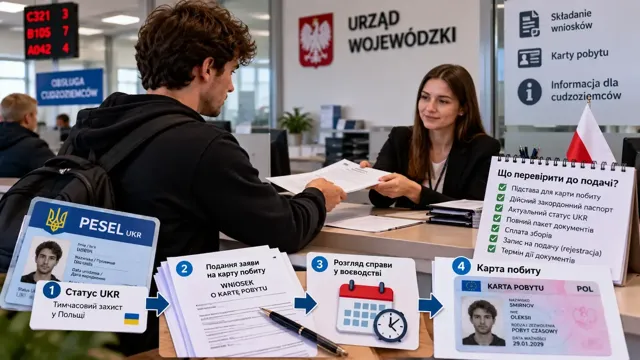
From UKR status to a residence card: the options and what to check first
Changing Employer in Poland as a Foreigner: Work Permit, Oświadczenie and Residence Card

Residence card refused: how to write an odwołanie within 14 days
