How hiring works in Poland: from the first call to your first week at work

Found our content useful? Add Jobework to your preferred sources and Google will show you our articles more often.
Most people who come to Poland for their first job picture it like this: someone calls, says "come", you arrive and start the next morning. In reality there are about ten steps between the first phone call and the first salary. Most of them take hours, a few take days. Knowing what should happen at each stage makes it much easier to notice when something is off.
This guide walks through the whole route in order: applying, the recruiter's call, the short interview, the offer, the paperwork you need before your first shift, what a normal first week looks like and what should worry you.
The stages at a glance
| Stage | What happens | How long it usually takes |
|---|---|---|
| Application | You leave your phone number or a short form, sometimes a CV | 5–10 minutes |
| Phone screening | A recruiter asks about experience, documents, start date and languages | 5–15 minutes; the call comes a few hours to 2–3 days after you apply |
| Interview | A short talk with a supervisor or manager, often on site | 15–40 minutes |
| Offer | Rate, contract type, hours, housing — ideally in writing | Same day or within 1–3 days |
| Medical check | An occupational doctor confirms you are fit for the job | 1 hour to 1–2 days |
| BHP training and contract | Safety training, signatures, your copy of the contract | 1–4 hours |
| First day | Induction, work clothes and safety gear, shift schedule | A normal shift with an introduction part |
| First week | Training on the job, getting used to the pace | 5–6 working days |
| First salary | Payment for the month worked plus a payslip | Usually by the 10th of the following month |
1. Applying
On most Polish job sites aimed at foreigners, a name, a phone number and a few words about yourself are enough. A CV helps, but for warehouse or factory work it is often optional. What really makes a difference is being specific in the message: "I have a UDT forklift licence, 8 months in a warehouse in Dubai, can arrive on the 15th." A recruiter who gets a hundred applications a day calls the clear ones first.
A few tips from practice:
- Give a number that works on WhatsApp, Viber or Telegram. Polish recruiters often write first and call later. International calls from Polish numbers are sometimes skipped, so a message is safer.
- Do not send a photo of your passport at the first step. Your document number will be needed later, when you are being registered. A request for a scan "to reserve your place" is a warning sign.
- Do not apply to 30 jobs in a row. Five to seven that really fit you are better. Otherwise you will not remember who is calling about what.
If you have no Polish work history yet, start with offers where training happens on site. You can browse all vacancies in Poland by conditions, and there is a separate list of jobs without experience.
2. The phone screening
This is not an interview in the classic sense. It is a quick check that you meet the basic conditions. Typical questions:
- Experience. Where you worked, how long, on what equipment. Be honest: in a warehouse it takes about an hour to see whether someone has really driven a forklift.
- Documents. Your legal basis for working in Poland. For most non-EU citizens this means a work permit (zezwolenie na pracę) or another document that lets this employer hire you, plus a visa or a residence card (karta pobytu). The recruiter will also ask whether you already have a PESEL number. Your answer decides how long the paperwork will take — a new work permit can take weeks or months.
- Start date. "When can you start?" is one of the main questions. If you give a date, keep it or warn them early.
- Languages. Polish, English, Russian, Ukrainian. Many production jobs need only basic Polish or none at all, but you will be asked.
- Housing. Whether you need employer-provided accommodation. It usually costs 350–550 PLN a month and is deducted from your pay.
Ask your own questions too: is the rate gross or net, what type of contract, how many hours a week, who pays for transport to the workplace. A normal recruiter answers this without trouble. If the answer to everything is "they will explain on site", note that as a minus.
3. The interview
For manual jobs, interviews in Poland are usually short. It may be a phone or video call with a manager, but on construction sites and in warehouses you will often just hear: "Come at 7:00, we'll have a look." You meet the supervisor (brygadzista), they show you the work, and sometimes ask you to try — stack a few pallets or drive a lap on a forklift.
What to bring: your passport or ID, certificates (UDT, welding, driving licence) and comfortable shoes. One thing to watch: a short skills demonstration is normal, but a full unpaid "trial shift" is not an interview. It is unpaid work.
If you are still abroad, the interview will be online and the employer will start the permit procedure only after you agree on the terms. That is why a clear written offer matters even more for people coming from outside the EU.
4. The offer: what must be in writing
A spoken promise is easy to "forget". Ask for the terms by message or e-mail before you buy a ticket. The offer should include:
- The rate, marked brutto (gross, before tax and social contributions) or netto (net, what you actually receive). In 2026 the minimum hourly rate is 31.40 PLN gross and the minimum monthly salary is 4,806 PLN gross, which on an employment contract is roughly 3,606 PLN net.
- The contract type: umowa o pracę (an employment contract with paid leave and sick pay) or umowa zlecenie (a civil-law contract of mandate, more flexible and with fewer rights).
- Hours and shifts: hours per shift, shifts per week, night shifts, how overtime is paid.
- Housing: address or at least the town, monthly cost, how many people per room, whether the cost is deducted from pay.
- Date and place of the first day: where to go, at what time, whom to ask for.
Also remember: nobody may charge you money for getting a job. Not "for registration", not "for a place on the list", not "for the visa invitation". Employment agencies in Poland must be listed in the KRAZ register, which you can check by the agency's name or number.
5. Documents to bring
The list varies a little between employers, but the core set is:
- passport, plus the visa, residence card or permit that allows you to work;
- your PESEL number, if you already have one (if not, the employer may help you apply);
- a Polish bank account number — if you do not have one yet, it is usually opened in the first days, and the salary simply arrives later;
- your address in Poland, even temporary, such as the employer's housing;
- certificates the job requires: UDT, driving licence, welding papers, diplomas;
- for students under 26 working on umowa zlecenie, a student card from a Polish school or university, because it changes how tax and contributions are calculated.
The employer registers you with ZUS (the social insurance institution) and handles the reports to state offices. Your job is to give correct data on time — a typo in a passport number can delay everything.
6. The medical check (badania lekarskie medycyny pracy)
Before you start work on an employment contract, you need a certificate from an occupational medicine doctor saying you are fit for this particular job. The employer gives you a referral (skierowanie) listing your position and the risk factors: noise, night work, work at height, driving a forklift. The employer pays for the check, not you.
Usually it is a general examination, sometimes an eye test, blood tests or an ECG, depending on the job. Forklift drivers and people working at height get a wider check. If someone tells you "pay for it yourself, we'll refund it later", ask when and how, and keep the receipt.
For jobs with food — food production, kitchens, some warehouses handling food — you also need a sanitary-epidemiological certificate (people still call it the "sanepid booklet", książeczka sanepidowska). It requires laboratory tests and the result may take several days, so start early if your job involves food.
7. BHP training
BHP stands for occupational health and safety. Before your first shift you must complete general training and on-the-job training. The general part covers the company's rules, evacuation and first aid. The on-the-job part is about your actual equipment: how the line works, where the emergency stop is, how to lift loads safely.
At the end you sign that you completed the training. Do not sign if it did not really happen — after an accident that signature can be used against you. If you do not understand the language, ask for an interpreter or a colleague who can explain. Large companies often have training materials in English or other languages.
8. Signing the contract
An employment contract in Poland should be confirmed in writing, as a rule before you start working. Do not agree to "work a week first, then we'll sign". Before you sign:
- check the rate, job title, hours and place of work — they must match what you were promised and, for non-EU workers, what is written in your work permit;
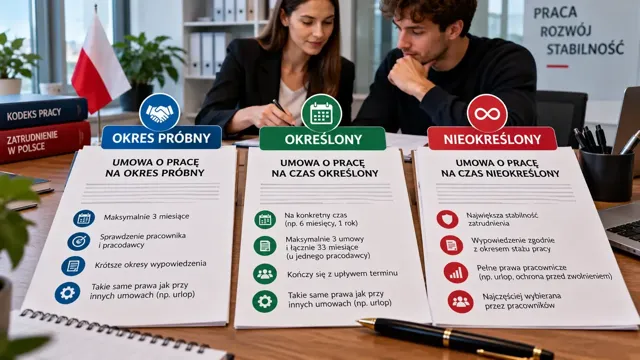
- look at the contract type and length: trial period (okres próbny), fixed-term or open-ended;
- if anything is unclear, take a photo of the page and translate it on your phone — this is normal and nobody will be offended;
- one copy of the contract is yours. Take it with you; "it stays in the office" is not good enough.
If you work through an employment agency, your contract is with the agency, not with the factory where you actually stand on the line. This is a normal arrangement — just make sure the agency is in KRAZ.
9. The first day
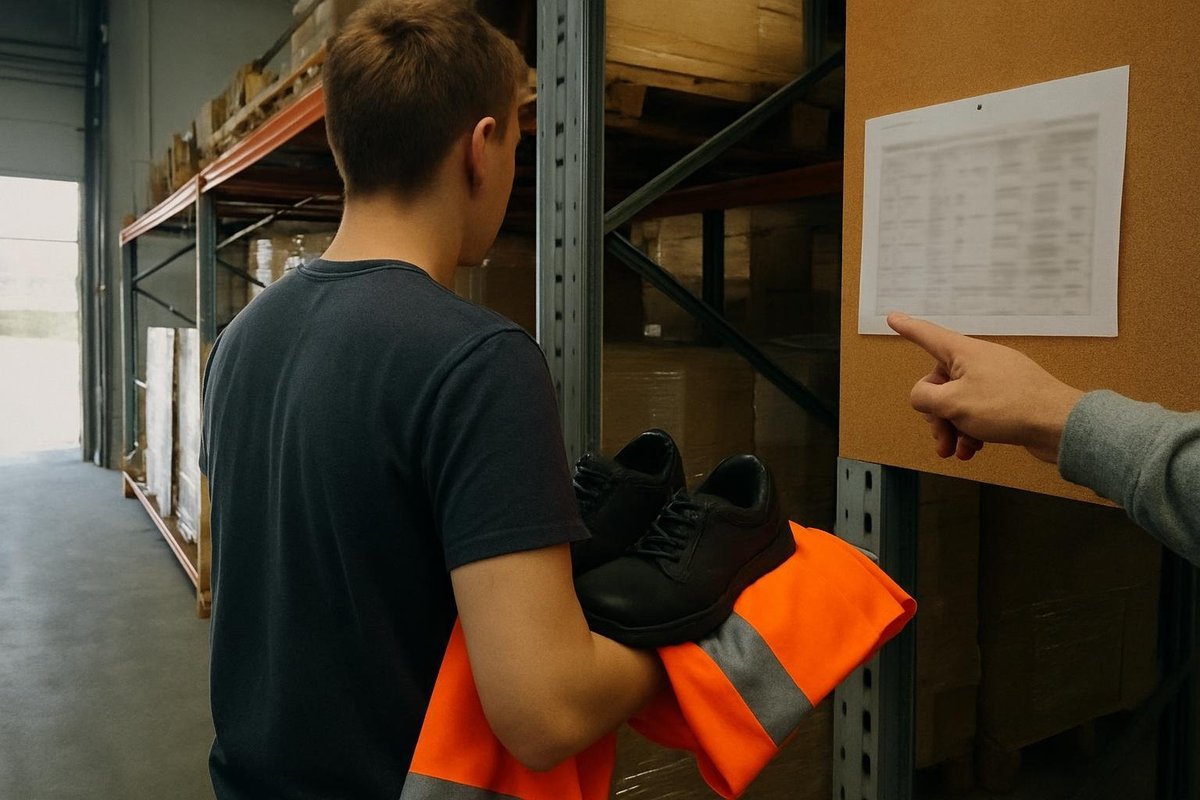
Your first day rarely looks like a normal shift. A supervisor or coordinator meets you and shows you the changing room, canteen and workstation. You receive personal protective equipment: gloves, safety shoes with a steel toe cap, a high-visibility vest, safety glasses, sometimes ear protection. The employer provides this free of charge; if you wear your own work clothes, you may get a cash allowance instead.
On day one, ask:
- how working time is recorded — card, chip, scanner or paper list;
- where the shift schedule (grafik) is posted and when next week's version appears;
- whom to call if you are sick and cannot come;
- when and how overtime is paid.
Write down your own hours every day, even just in your phone notes. When the first payslip arrives, you will be able to compare.
10. The first week: what is normal and what is not
Normal: being more tired than you expected, especially in a warehouse or on a production line. Not reaching the target (norma) in the first days — most places give you time to get there. Being moved between sections while they find the right place for you. Getting remarks from the supervisor; the tone can be blunt, but that is not yet a conflict.
Red flags:
- someone takes your passport "for safekeeping" — this is not allowed, your documents stay with you;
- you have been working for several days and still have no contract;
- the recorded hours are lower than what you actually worked;
- the housing suddenly costs more than agreed, or new "fines" appear without any document;
- you are told to work without protective equipment or on machines you are not trained or certified for.
If you signed a trial-period contract, both sides can end it faster than a normal one. That does not mean you can go unpaid for the days you have already worked.
11. Your first salary and the payslip
Most employers pay for a month by the 10th of the following month. So if you start on 5 November, your first money will come around 10 December. Plan for that: you will need cash for food and transport for the first five or six weeks. Some employers offer an advance (zaliczka), but that is goodwill, not an obligation.
Ask for your pasek wypłaty, the payslip. It shows the hours counted, the gross rate, deductions (ZUS contributions, income tax, health insurance), the housing deduction and the net amount. Compare the hours with your own notes. Mistakes are common and they do get corrected — if you raise them straight away.
12. If something goes wrong
First, talk calmly to your coordinator or supervisor, preferably in writing on a messenger, so there is a record. If that does not help, Poland has the Państwowa Inspekcja Pracy (PIP), the National Labour Inspectorate. It gives free advice and accepts complaints, including from foreign workers, and you can ask for your name not to be revealed to the employer. Current contact details and the advice line are on the official PIP website.
Keep these things just in case: a copy of your contract, your own record of hours, photos of shift schedules, messages with the recruiter, and payslips. With them it is much easier to prove your case.
Quick checklist
- Terms in writing before you travel: gross or net rate, contract type, hours, housing cost.
- No payments for getting the job; the agency is in the KRAZ register.
- Medical check paid by the employer, done before the first shift.
- BHP training actually given, not just signed for.
- Contract signed before you start, with your own copy.
- Passport always with you.
- Hours written down by you every day.
- First salary around the 10th of the next month, plus a payslip.
If this article helped, mark Jobework as a preferred source — you'll see our new materials more often in Google search.
Subscribe to our newsletter:
Latest Posts:



More in this section: Umowa o pracę: employment contract in Poland
Okres próbny, określony, nieokreślony: three types of employment contract in Poland

Umowa o pracę vs umowa zlecenie: which is better for workers in 2026

Holiday on umowa o pracę: 20 or 26 days and how to count yours