Bank Account, SIM Card and Internet in Poland for Foreigners: What to Set Up in Your First Week

Found our content useful? Add Jobework to your preferred sources and Google will show you our articles more often.
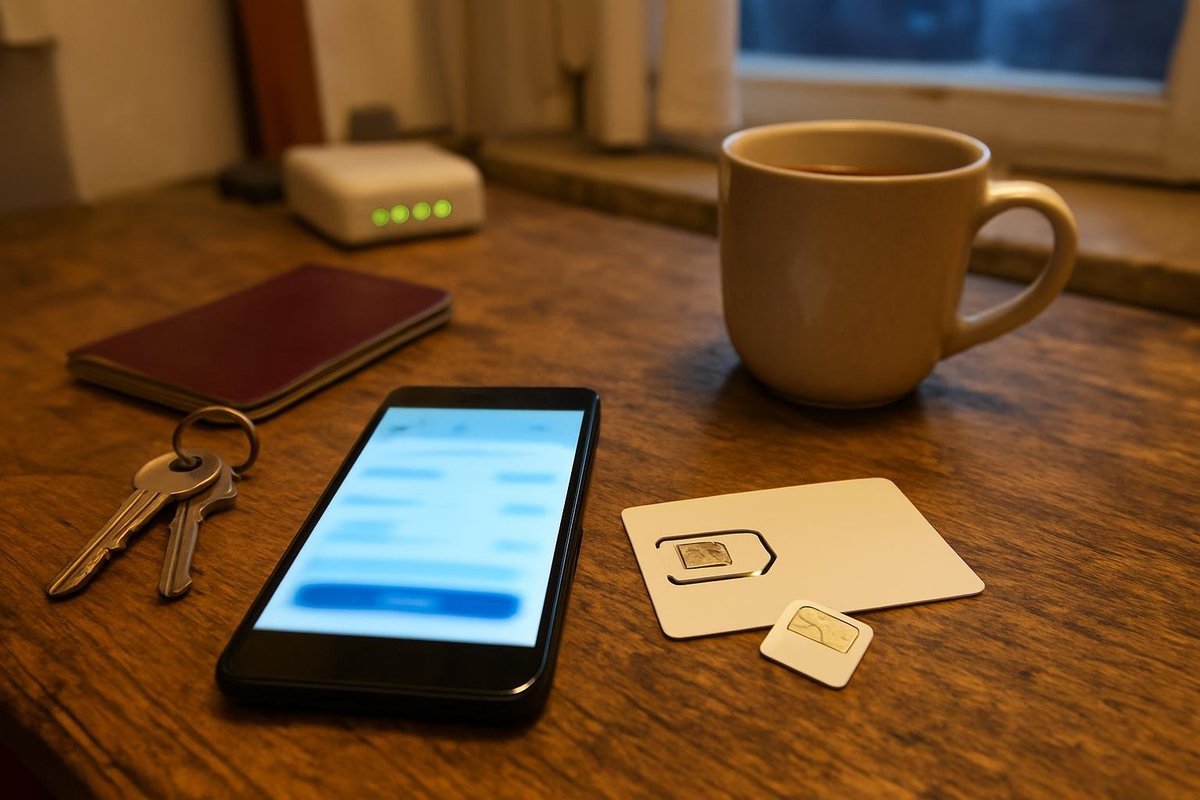
The first week in Poland usually disappears into paperwork, safety training and getting used to the accommodation. Then, around day five, the payroll office asks for your account number, the coordinator wants a Polish phone number, and the bus driver will not sell you a ticket for cash. A bank account, a local SIM card and a working internet connection are the three things that make everyday life here possible. This guide explains how each one works, what documents you need, what it costs, and where newcomers most often lose money.
Why you need a Polish bank account
Your home bank card will probably work in Polish shops, at least for a while. For salary, though, a foreign account is a poor choice. Under the Polish Labour Code, salary on an employment contract (umowa o pracę) is, as a rule, paid by bank transfer; cash is possible only if the worker asks for it in writing. In practice almost every employer and agency wants a Polish account number. A domestic transfer arrives within hours and costs nothing. A transfer to a foreign IBAN takes longer, can carry fees on both sides and is sometimes held for compliance checks, which means waiting for money you have already earned.
There are other reasons too. Rent, utility bills, fines and tax top-ups are paid by bank transfer in Poland. If you get a tax refund after filing your annual PIT return, the tax office sends it to an account. And BLIK, the payment system almost every Pole uses on their phone, works only with Polish banks.
Documents you will be asked for
Requirements differ a little from bank to bank, but the usual set looks like this:
- Passport — the main identity document for non-EU citizens. Make sure it is valid for at least a few more months.
- Proof of legal stay — a national visa (type D), a residence card (karta pobytu) or a stamp confirming visa-free stay. Some banks open accounts only for people whose visa or permit is valid for a certain minimum period, so bring whatever you have.
- PESEL — the Polish national identification number. It is not always required for an account, but it makes everything easier: faster opening, access to online services, fewer questions. Employers often apply for it on your behalf, or you can apply at the municipal office (urząd gminy).
- A Polish address — the address of your employer-provided housing is fine. Registered residence (zameldowanie) is normally not needed to open an account.
- A Polish phone number — the bank sends confirmation codes by SMS. This is why it makes sense to buy a SIM card first.
Some branches also ask for an employment contract or a short letter from your employer (zaświadczenie o zatrudnieniu), especially when your visa is short. If you do not have one yet, explain that you have just started and are waiting for your first salary. Most branches will still open a basic personal account.
Opening an account online or in a branch
Large Polish banks let you open an account through their app: you photograph your document, take a selfie or join a short video call with a consultant. For EU citizens with an ID card this takes about ten minutes. With a non-EU passport, online opening often fails: the system may not recognise the document, may ask for a PESEL, or may stop halfway. If the app refuses twice, do not keep trying for days. Go to a branch.
In a branch, the whole process usually takes 30 to 60 minutes. In bigger cities you will often find staff who speak English, and some banks have contracts and price lists in English. Ask for a personal account (konto osobiste) with a debit card and mobile banking. Bring your phone with the Polish SIM card already working, so the consultant can help you install the app and switch on BLIK before you leave. A physical card is usually posted to your address within one or two weeks; until then you can pay with your phone.
What a bank account costs
Many banks advertise accounts at 0 PLN, but there are conditions. Typical ones: a minimum monthly inflow to the account (for example 1,000–2,000 PLN, which a full-time salary easily covers), or a few card payments per month. If you do not meet the condition, the monthly fee is usually somewhere between 5 and 15 PLN, and the card may have its own fee. Before you sign, ask for the fee table (tabela opłat i prowizji) and ask directly: "What will I pay if my salary comes in every month?"
Withdraw cash from your own bank's ATMs, where it is normally free. Independent ATMs at train stations and in tourist areas often charge a fee and offer a "convenient" currency conversion that is anything but. When an ATM or card terminal asks whether to charge you in your home currency or in złoty, always choose PLN.
BLIK explained
BLIK is a payment system built into the mobile apps of Polish banks. You open your banking app, it shows a six-digit code valid for two minutes, and you type that code at a shop till, in an online checkout or at an ATM. Then you confirm the payment in the app with your PIN. No card needed. Online shops, ticket machines and even some market stalls accept it.
The feature people love most is the phone transfer (przelew na telefon BLIK). Your colleague paid for the pizza, your flatmate bought cleaning products for the whole room — you send money just by entering their phone number, and it arrives in seconds. BLIK also lets you withdraw cash from many ATMs without a card.
One safety rule: never read a BLIK code to anyone over the phone and never send it in a chat. Most scams in Poland work exactly like this. Someone pretends to be a friend in trouble, a bank employee or a buyer on a classifieds site and asks for "just the code". A bank will never ask you for it.
Sending money home
From a Polish account you can make an international SWIFT transfer, but bank fees and exchange rates for non-euro currencies are often poor. Many workers use online money transfer services instead: you see the exchange rate and the fee before you send, and money usually reaches a bank account or mobile wallet at home within minutes or hours. Compare two or three options on the same amount — on 2,000 PLN the difference can easily be the price of a week's groceries. Check that the service is licensed in the EU and never send money for a "job fee": charging a candidate for a job is illegal in Poland.
SIM cards: prepaid or contract
Prepaid (na kartę)
This is the easiest start. A starter pack costs about 5–10 PLN at a newsagent kiosk, petrol station, supermarket or operator's shop. Since 2016 every prepaid SIM in Poland must be registered to an identity document; for foreigners that means a passport. You can register at the point of sale or in an operator's shop. An unregistered SIM simply will not work, so do not buy a "ready to use" card from strangers.
Monthly bundles usually cost 25–40 PLN and include unlimited calls and SMS within Poland and anywhere from a few dozen to over a hundred gigabytes of data. You top up at kiosks, in the operator's app or by BLIK. International calls are charged separately and can be expensive; check whether the operator offers a cheap add-on for your home country, or just call through messaging apps over Wi-Fi.
Contract (abonament)
A contract is cheaper per gigabyte and is often bundled with a smartphone paid in instalments. But the operator will usually ask for a PESEL, proof of legal stay and sometimes proof of income, and the contract normally runs for 12 or 24 months. If you are not sure you will stay in Poland for a year, a contract is premature. You can end it early, but you will have to pay back part of the discount (ulga) you received when you signed.
Keep your home number active if you can, at least on the cheapest plan. Banks and government services back home still send codes there, and losing access to it can lock you out of your own account.
Home internet
If you live in employer-provided accommodation, Wi-Fi is usually already there and included in the monthly charge, which is typically 350–550 PLN. Ask the coordinator about it before you move in. In larger worker houses with twenty people streaming in the evening, the connection can crawl; a generous mobile data bundle on your prepaid SIM is the simplest fix.
If you rent a room or flat yourself, you have three main options:
- Internet included in the rent — the best choice for a short stay. Make sure it is written in the rental agreement.
- Mobile router or home internet on a SIM card — roughly 40–80 PLN a month, often without a long contract. Works well if 4G or 5G coverage in the building is good.
- Cable or fibre — the fastest and most stable, but almost always tied to a contract.
The 24-month contract trap
That attractive price in an advert usually means a 24-month contract. Leave earlier and the provider can, as a rule, charge you back part of the discount you received, which may add up to several hundred złoty. A contract without a fixed term, or for 12 months, costs maybe 10–20 PLN more per month but lets you leave without penalties. Before signing, ask about the notice period (okres wypowiedzenia) and what happens to the router.
To cancel, you submit a written notice (wypowiedzenie umowy) in the shop, by post or through your online customer account. Keep a copy with the date on it. Return the router and any TV box by the deadline, or you will be billed for the equipment.
Apps worth installing
In big cities you can buy public transport tickets in ticket apps or simply tap a contactless card on the machine inside the bus or tram. Ticket inspectors are common and a fine runs to a few hundred złoty, so do not risk it. Add a maps app with public transport routes, your banking app and your mobile operator's app to see how much data you have left, and you are covered. Once you have a PESEL, the government app mObywatel and a Profil Zaufany (a free trusted profile for e-government) can give you access to some online public services, for example tax documents.
First-week checklist
| Day | Task | What to bring |
|---|---|---|
| 1 | Buy and register a prepaid SIM card | Passport, 30–50 PLN |
| 1–2 | Check the Wi-Fi in your housing; buy extra data if it is weak | Phone |
| 2–4 | Apply for a PESEL if your employer has not done it | Passport, visa or permit, housing address |
| 3–5 | Open a bank account, install the app, activate BLIK | Passport, proof of legal stay, Polish phone number |
| 5–7 | Give your account number to the employer in writing | IBAN (PL + 26 digits) |
Mistakes we see again and again
- A single wrong digit in the account number given to payroll. Copy the IBAN from the app; do not retype it by hand.
- Signing a 24-month internet contract while planning to stay six months.
- Forgetting to return the router after cancelling.
- Reading a BLIK code to a "bank employee" on the phone.
- Keeping the whole salary in cash in a shared room.
- Buying an unregistered SIM from someone in a group chat.
If you are still looking for work, browse current job offers in Poland — many ads say up front whether housing is provided and how salary is paid. The first salary usually arrives around the 10th of the following month, so keep enough money to cover your first three or four weeks.
If this article helped, mark Jobework as a preferred source — you'll see our new materials more often in Google search.
Subscribe to our newsletter:
Latest Posts:


More in this section: Salary in Poland

Night, overtime and holiday work: which supplements you get in Poland
How to send money home from Poland: bank transfer, online services, cash — fees, limits and safety
Pasek wynagrodzeń: how to read your Polish payslip and spot mistakes