Who can work in Poland without knowing Polish?
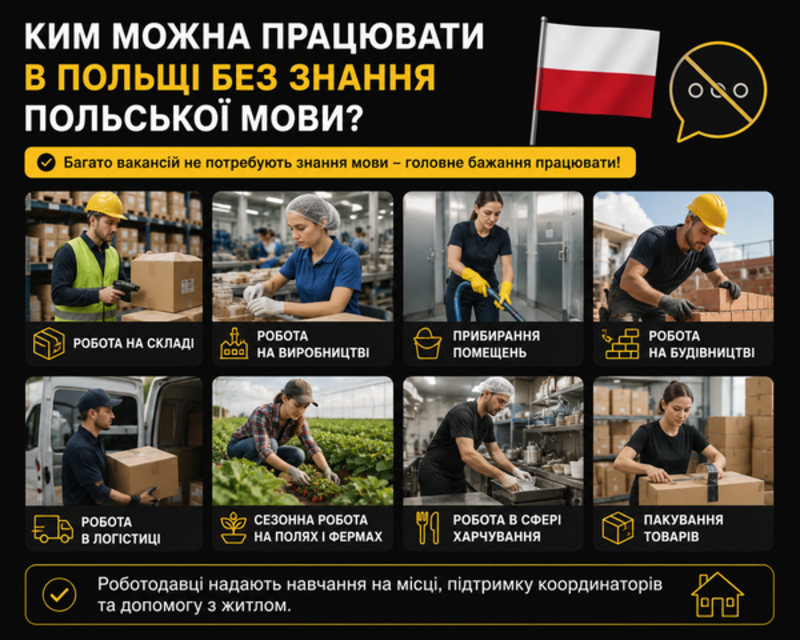

Moving to Poland and finding a job without knowing Polish is absolutely possible. Many people worry that a lack of language skills will prevent them from getting hired, but there are actually quite a few jobs where fluent Polish is not required.
The easiest opportunities can often be found in warehouses, manufacturing, logistics, packaging and construction. For these positions, employers may be more interested in reliability, willingness to work and the ability to follow instructions than in advanced language skills.
Still, having no Polish at all can make everyday work more difficult. Even knowing a few basic words and understanding simple instructions can make the first weeks much easier.
Warehouse Jobs
Warehouse work is one of the most common options for people who arrive in Poland without knowing the language.
Employees may be responsible for picking orders, packing products, sorting goods, scanning items or preparing shipments.
In many warehouses, the work follows clear procedures, so there is no need for constant communication in Polish. After initial training, employees usually perform specific tasks throughout their shift.
With time, it is also possible to move into a more specialized position. For example, obtaining UDT qualifications can open the door to forklift operator jobs.
Manufacturing Jobs
Production companies also frequently hire workers who have limited Polish skills.
Depending on the workplace, duties may include assembling components, checking finished products, operating simple machinery, sorting goods or packaging products.
New employees are often trained directly at the workplace, which means previous experience and advanced Polish are not always necessary.
Attention to detail, discipline and the ability to follow safety and work instructions are usually more important.
Packing and Sorting Jobs
Packing jobs are another good option for people who do not speak Polish.
Work can be found in factories, warehouses and logistics centres. Typical tasks include packing products, applying labels, checking goods, sorting items and preparing orders for shipment.
Once employees learn the process, the work usually becomes straightforward and does not require constant conversation.
Can You Work as a Welder Without Speaking Polish?
In some cases, yes.
For a welder, professional skills are often more important than language proficiency. Someone with experience in MIG/MAG welding who understands the technology and safety rules may be able to find work even with limited Polish.
However, language should not be completely ignored. Welders need to understand workplace instructions, safety requirements and basic commands.
For a skilled worker, even basic Polish can therefore be a significant advantage.
Construction Jobs
Construction is another sector where it is possible to start working without strong Polish skills.
Depending on previous experience, beginners may find jobs involving general labour, installation, insulation, masonry and other construction tasks.
It can be especially helpful when a team already includes Ukrainian- or Russian-speaking workers, as this makes communication and adaptation easier.
However, Polish becomes more important when the job involves machinery, complex processes or greater responsibility.
What About Working as a Driver?
It depends on the specific job.
A C+E driver may not need to speak Polish throughout the entire working day, but communication with dispatchers, warehouse employees and other people is often unavoidable.
For this reason, knowing Polish or another language used by the company can be a major advantage. This is particularly important for jobs involving regular contact with customers or Polish businesses.
Which Jobs Are Difficult Without Polish?
Some professions require strong communication skills because dealing with customers is an essential part of the job.
For example:
- shop assistant;
- receptionist or administrator;
- customer service specialist;
- telephone operator;
- waiter;
- service industry worker.
If you need to communicate with Polish customers throughout the day, having no Polish can be a serious obstacle.
When looking for work, it is therefore worth considering not only the job title but also how much communication the position actually involves.
Do You Need to Learn Polish Before Finding a Job?
Not necessarily.
For many people, a better approach is to combine work with learning the language. You can start with a position where Polish is barely required and gradually improve your language skills while living and working in the country.
At first, it is enough to learn practical vocabulary: numbers, days of the week, names of tools, basic commands and words related to workplace safety.
Even a basic vocabulary can significantly increase the number of jobs you can apply for.
How to Check Whether a Job Is Suitable Without Polish
Before applying, it is worth finding out a few things:
- Is Polish required?
- Is training provided?
- What language does the coordinator speak?
- Is previous experience necessary?
- Will you need to work with Polish documents?
- How much communication is involved in the job?
This can help you avoid a situation where a vacancy looks suitable online but turns out to require a higher level of Polish during the interview.
Can You Really Find a Job in Poland Without Speaking Polish?
Yes. Not knowing Polish does not mean you cannot find employment in Poland.
For many newcomers, warehouses, manufacturing, packaging, logistics and certain construction or technical jobs are among the easiest places to start. In these positions, understanding basic instructions and performing your duties responsibly can often be enough.
At the same time, learning Polish is definitely worth it in the long term. Better language skills mean access to more vacancies, better working conditions and more qualified positions.
So, not knowing Polish is not a barrier that makes employment impossible. It is simply a limitation on the number of opportunities available. You can start without the language, but the better your Polish becomes, the more options you will have.
Subscribe to our newsletter:
Latest Posts:
Latest Posts:

Where is the best place to look for a job in Poland in 2026: 10 cities with the most opportunities
Working as a plowman in Poland: salaries, UDT and requirements in 2026

How to change a passport in Poland for Ukrainians in 2026

How much does it cost to live in Poland in 2026: housing, food and transportation costs